






Germany has allocated over €1.3 billion, or $1.51 billion USD, in subsidy payments to three large Danish green hydrogen projects, offering a significant boost to international hydrogen trade as well as strengthening plans to bring renewable hydrogen to the largest industrial economy of Europe.
The funding for Danish green hydrogen projects has been granted via the European Hydrogen Bank’s Auctions-as-a-Service mechanism, a model that enables member states to utilise EU auction infrastructure whilst deploying national funding. Led by Copenhagen Infrastructure Partners, European Energy as well as Everfuel, the three successful initiatives are projected to generate a total of roughly 78,000 tonnes of renewable hydrogen per year. Deliveries are expected to start in 2031 via the planned hydrogen interconnector between Denmark as well as Germany.
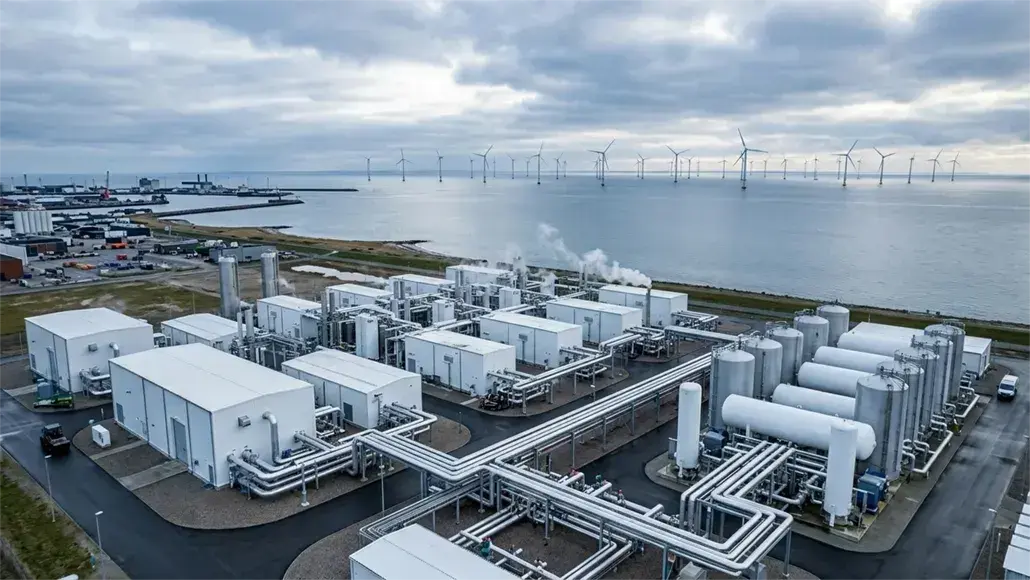
Copenhagen Infrastructure Partners won the biggest award, taking home €777 million or $903 million USD for a 240MW hydrogen project in Esbjerg. The subsidy is equivalent to almost €1.70/kg or $1.97/kg USD of hydrogen generated. The endeavour is part of the bigger HØST Esbjerg development, which eventually aims to have 1GW of electrolysis capacity that will be able to produce as much as 120,000 tonnes of green hydrogen per year.
European Energy has secured €228 million, or $265 million USD, in order to build another 150 MW electrolyser at its Kasso plant located in southern Denmark. The subsidy is approximately €1.07/kg or $1.24/kg USD of hydrogen. The company intends on integrating the project with its current e-methanol operations that went into full commercial operation in 2025. The award was another sign of the significance of establishing a hydrogen infrastructure between Denmark and Germany, said the management.
Meanwhile, Everfuel secured €244.9 million, or $285 million USD, in order to finance the first 200 MW stage of its wider Project Frigg construction in Vejen. The subsidy level of nearly €0.98/kg or $1.14/kg USD was the lowest of the winning bids, demonstrating the increasing competitiveness of large-scale European hydrogen projects. Project Frigg is aimed at serving industrial customers within Germany through the future pipeline network and has the potential to expand to a maximum of 2 GW of electrolyser capacity.
The awards have strategic significance since they directly connect hydrogen production with future cross-border infrastructure. All three projects are anticipated to use the planned Danish-German hydrogen pipeline that has become one of the most important envisioned hydrogen transport corridors of Europe. The projects thus represent not just production capacity, but also a preliminary anchor demand case for the broader European hydrogen infrastructure.
The scheme is a sign that Germany is increasingly realising that it will not be able to meet future industrial needs with domestic hydrogen production. The country continues to promote importing renewable hydrogen as a key component of decarbonising sectors that include steel, refining, and chemicals as well as heavy transport.
The findings also show how the hydrogen market in Europe is moving from public statements to commercially organised initiatives with long-term financial support. The three Danish projects are now among the most sophisticated large-scale hydrogen export initiatives in Northern Europe, and 10-year subsidy agreements are anticipated to be finalised by October.
If carried out as intended, the projects would be considered among the first major instances of a specialised renewable hydrogen supply chain linking production resources in one European country to industrial consumers in another directly, offering a significant test case for the continent’s broader hydrogen import approach.