

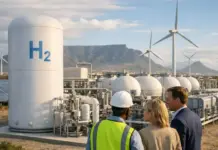

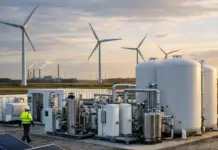



The war by US President Donald Trump in Iran has barely been underway for six weeks, and the world’s leading defense supplier Rheinmetall has already proposed creating hundreds of green hydrogen microgrids right across Europe. The aim is to lock in a hyper-local domestic supply of drop-in synthetic military fuels using renewable energy, carbon capture, and water.
Why Does Europe Lack Enough Green Hydrogen Today?
If Iran agrees to open the Strait of Hormuz and the price of fossil fuels starts to drop, the Reinmetall vision may go down the memory hole. It might happen any time soon or not, but the pieces of technology are there to make green hydrogen for military fuels at scale. Some military suppliers are also beginning to champion the use of hydrogen fuel cell electric combat drones that are refueled in the field by transportable microgrids that use solar energy to make green hydrogen from water.
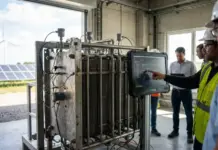
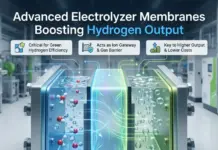
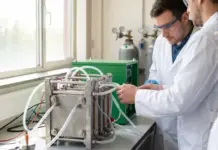
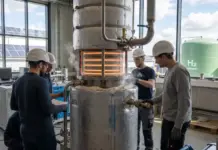
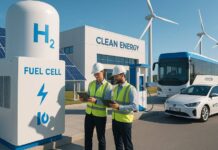
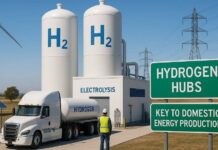
New to the subject? Well, green hydrogen is essentially hydrogen pushed out of water using a jolt of electricity in an electrolyzer system. Biomass and plastic waste are other options, but water electrolysis has attracted the most interest from public and private investors so far. Such a use case is fuel cells. Hydrogen is a fuel that also burns and can be combined with captured carbon to make drop-in liquid electrofuels or e-fuel replacements when it comes to fossil fuels.
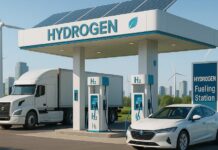
The green label is generally reserved for electrolysis systems powered by electricity from wind, solar, and other renewables. European energy planners once imagined a broad slate of uses for green hydrogen, from granular applications such as fuel cell vehicles and building HVAC systems to refining, fertilizer production, and various other industrial applications.
China has become an industrial-scale giant, while Europe’s fragmented approach has left a trail of project failures and broken dreams over the years. There are still some stakeholders, but commercial traction has been slow to develop. That’s not too surprising. In transportation, for example, green hydrogen is battling not only cheaper fossil fuels but also an increasing wave of ever-improving EV batteries.
More green hydrogen when it comes to Europe
Suddenly, Trump’s war in Iran has lit up the competitive picture for green hydrogen and e-fuels in transport. Another factor is Trump’s emphasis on backing up Russian President Vladimir Putin at the expense of America’s European allies as the EU scrambles to reduce its dependency on imported fossil fuels.
That’s why Rheinmetall has concentrated a comparable number of points of light on drop-in e-fuels for military applications. A secure supply of fuel when it comes to the armed forces is a fundamental requirement for their ability to wage war, the company says.
They highlight, investments in local renewable energy sources and in the ability to synthesize e-fuels will guarantee the energy supply for the armed forces in Europe as an essential ability suitable for war.
Why green hydrogen for military fuels and why not batteries or, for that matter, fuel cells? Rheinmetall makes a case for the drop-in liquid fuel solution –
It is well to be noted that in military operations, the fuel consumption can be 20 to 60 liters per soldier per day. But fossil fuel logistics, constructed for peacetime, grow more brittle all the time. Synthetic e-fuels are the only adaptable option that matches the energy density, storability, and versatility of conventional fuels and are therefore essential for modern defense readiness.
How will it function?
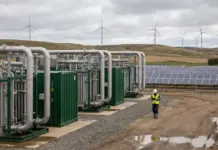
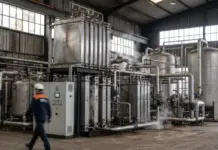
Take it for what it is. For its part, Rheinmetall has already started laying the pieces in place to cover Europe with modular e-fuel plants under its new Giga PtX project.
In June 2025, months before Trump began his war in Iran, Rheinmetall announced a strategic partnership with INERATEC, the German PtL – Power-to-Liquid firm with the goal of deploying the company’s modular systems for military operations. The two companies first teamed up in 2024 to build a pilot e-fuels plant. In the latest development, on April 17, leading electrolyzer producer ITM Power stated that it too has begun a collaboration with Rheinmetall.
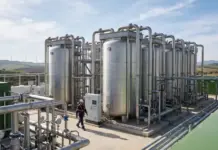
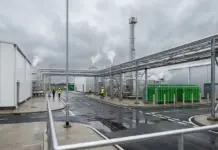
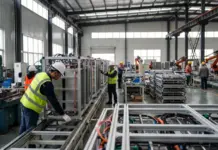
The collaboration will concentrate on Rheinmetall’s Giga PtX project, which is intended to create a Europe-wide network of autonomous synthetic fuel production plants for the NATO armed forces, intended to strengthen defence energy resilience, sovereign fuel capacity, and tactical readiness, said ITM.
ITM said the plan involves several hundred facilities that would use up to 50 megawatts of electrolysis to produce 5,000 – 7,000 tonnes, which is roughly 5,500 – 7,700 US tons of liquid fuel per year.
According to ITM, synthetic fuels will be essential for defence and other mission-critical sectors where electrification is not possible and a secure, reliable supply of fuel is paramount.
What’s up with the U.S.A.?
That said, the US has plenty of fossil fuels of its own, so energy planners here aren’t worried about Iran sealing off the Strait of Hormuz. Forget that. What comes out of the soil in the US is irrelevant to the global market for coal, oil, and natural gas, and price spikes routinely ripple out to these shores.
And that means the U.S. Department of Defense will be paying more. The Pentagon is already being hammered by climate impacts that disrupt training programs and threaten to swamp coastal facilities. Another reason why DOD should do its part to decarbonize globally through the use of e-fuels and other, more environmentally friendly locally sourced alternatives is the volatility of the global fuel market.
Except, no. Two years ago, the US Department of Energy implemented a $7 billion clean hydrogen program in place to increase domestic production capacity, decarbonize it, and diversify it. The program also supported the Department of Defense’s continued target when it came to sustainable fuels and net zero goals, as well as climate adaptation.
Now all those programs are in the Trump chopper, like it or not. Rising fuel and fertilizer costs are also hitting US farmers with a tsunami of hurt, and hydrogen is the key ingredient in ammonia fertilizer.