

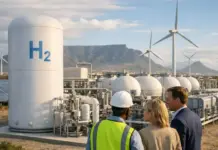

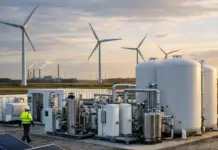
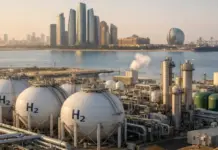





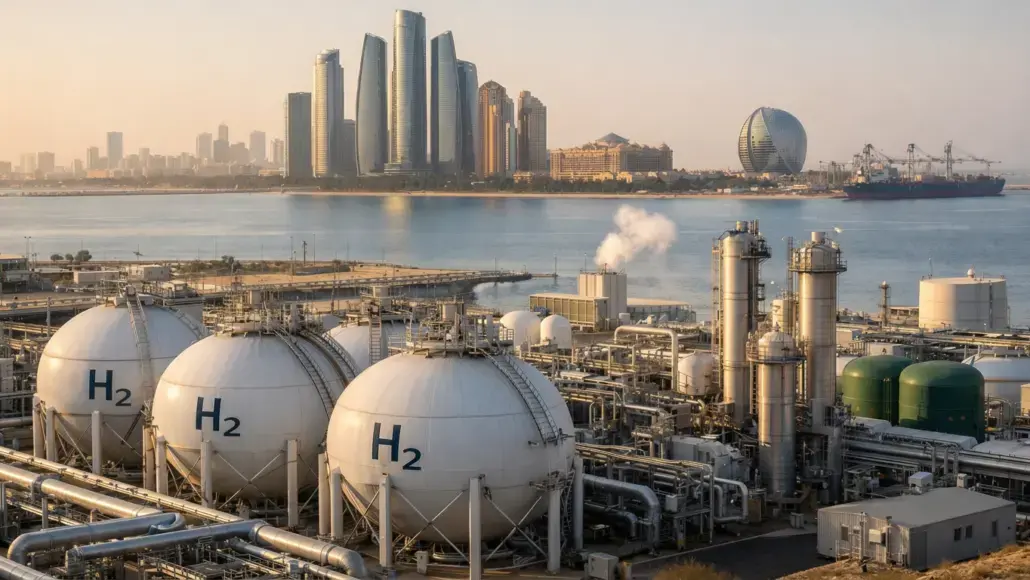

Abu Dhabi is becoming known as one of the most strategically favourable locations in the global hydrogen economy with low-cost production, increasing industrial capacity and billions of dirhams of prospective export possibilities, based on a new report from the Abu Dhabi Chamber of Commerce and Industry – ADCCI.
As per the report, in its quest to be a global hydrogen economy, emirate is moving from policy pledges to operational projects, while other international hydrogen markets are experiencing slower growth amid global policy ambiguity.
The Business Intelligence Department of ADCCI reported in its June 2026 report titled – Abu Dhabi’s Positioning in the Hydrogen Economy that Abu Dhabi is one of the nations with the most strategic advantages in the global hydrogen race.
It is well to be noted that the UAE has plentiful solar resources, an effective electricity infrastructure, robust industrial capacity, and a low cost of capital.
The structural advantages of the UAE are projected to place it among the lowest-cost producers of hydrogen and ammonia in the world by 2030, allowing for exports to early demand centres such as the European Union, Japan as well as South Korea.
The hydrogen economy of Abu Dhabi
Abu Dhabi has additionally set itself a target of producing 1.4m tonnes per year of low-carbon hydrogen by 2031.
The report indicates a global trend away from exporting pure hydrogen and in favour of higher-value derivatives such as –
- Green ammonia
- Methanol
- Synthetic fuels
- Sustainable Aviation Fuel – SAF
As stated by ADCCI, Abu Dhabi intends to position itself within this value chain by means of a number of initiatives including –
- Development of methanol as well as SAF projects with green hydrogen and captured CO2
- Evaluation of e-methane production and bunkering infrastructure
- Growth in synthetic fuels as well as green ammonia
The initiatives could as well unlock billions of dirhams of untapped export potential by 2029, while also generating jobs and lowering emissions, the report said.
Even with strong global momentum, only roughly 12% of low-carbon hydrogen projects around the world have attracted verified customers, the report says.
Customer demand is vital
It points out Abu Dhabi’s customer-aligned projects as an example to speed up the sector.
Examples consist of the already operational EMSTEEL– Masdar green steel pilot, defined as the first hydrogen-based steel project in MENA, and offtake agreements entered with Modon and Aldar so as to supply green steel to sustainable construction projects.
Apparently, long-term offtake agreements are critical to accelerating investment and scaling the hydrogen economy, especially in the sectors that can afford to pay the green premium, the report adds.
ADCCI also found possibilities to export hydrogen technologies and equipment, in addition to hydrogen production.
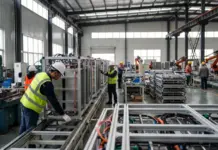
The report said that the industrial zones of Abu Dhabi, such as KEZAD, and logistics infrastructure located at Khalifa Port make the emirate a manufacturing and re-export center.
Expected export possibilities by 2029 are –
- Green hydrogen production equipment worth AED2.3bn or $626m)
- Port infrastructure elements around AED 1.2bn or $327m
- Blending projects of AED1.3bn or $354m
- Potential export markets consist of China, Germany, United Kingdom, United States as well as Australia.
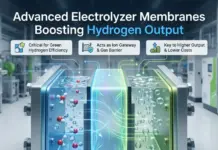
It also refers to a 2023 contract signed by ADNOC and John Cockerill Hydrogen as well as Strata Manufacturing to build electrolysers in the UAE for domestic use and export, calling it the first of its kind in the region.
ADCCI stated that the report forms an element of its broader efforts to deliver data-driven intelligence to promote growth in the private sector and advance the long-term economic diversity goals of Abu Dhabi.