

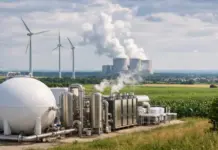
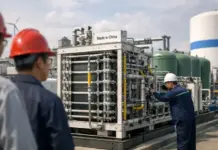
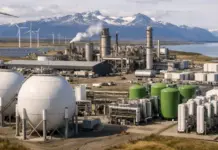
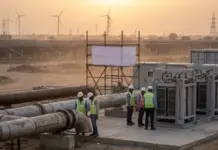
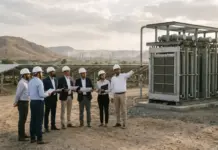
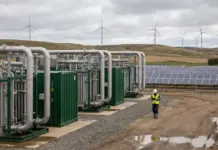




As part of a stimulus package, Germany allocates €9 billion to expand green hydrogen role to help end its dependence on coal. The government has gone on to agree to a plan on how to spend the investment for the project.
Hydrogen, which is the most abundant element in the entire universe, has often been regarded as a way to power vehicles as well as energy plants, but it is just too costly.
Most hydrogen, which is used in today’s times, is produced via reforming natural gas, which also goes on to emit a lot of carbon dioxide – CO2. On the other hand, green hydrogen gets extracted from water by way of electrolysis, but it is still a very energy-intensive process.
The massive advantage that hydrogen has, however, is that it can be stored easily as compared to other forms of renewable energy and for much longer periods of time. And which is why it is a key part of the energy transition – Energiewende strategy of Germany, as the No. 1 economy of Europe looks to become carbon neutral by 2050. It is well to be noted that it was only recently that the government announced – it aimed to have 5 gigawatts -GW of hydrogen production capacity by the end of the decade with another 5 GW ten years later.
As Germany allocates €9 billion to expand green hydrogen role, it could potentially see hydrogen make up almost 10% of the total electricity capacity of the country, was unleashed as part of a stimulus of $147bn in order to enable a reboot of the economy at the time of the COVID-19 pandemic. The commitment of hydrogen is a part of almost €40 billion, which has been allocated for spending related to climate.
Hydrogen strategy not firmed up as yet
Ministers on August 26, came together so as to debate and give a nod to a joint strategy on how to make use of the resources that are freed for the green hydrogen project.
Summing up outcomes of the Cabinet meeting, Peter Altmaier, the German Economy Minister, said the strategy was to use green hydrogen where it actually mattered most and where it was going to have the biggest of the impact. He talked about decarbonizing the industrial processes, especially mentioning the requirement for Germany to manufacture climate-neutral steel.
Reuters went on to report on August 26, that Thyssenkrupp, the German steel giant, and along with it the largest utility of the country, RWE, have plans to forge a long-term green hydrogen alliance, with RWE supposed to supply Thyssenkrupp with green energy and hence in a way massively decrease the latter’s ecological footprint.
Svenja Schulze, the German Environment Minister, told reporters that green hydrogen is going to lead to pushing climate protection efforts and that a nation like Germany should in any way afford very intricate and costly hydrogen production.
Schulze also said that “what we need now are really big industrial facilities, as potentially we will also be able to sell our product to clients across the globe.”
As per Andreas Scheuer, the German Transport Minister, he would want his country to become a pioneer in hydrogen production across Europe and even beyond, stating that the concepts in greener mobility could speed that up.
So as to have the production of water-extracted hydrogen to be a majorly carbon-free process, it is indeed going to need an incredible amount of ramp-up in production when it comes to wind and solar energy. And only once the renewable energy production takes its pace can green hydrogen be rolled out across power stations and heavy industrial processes and also replace gas as well as oil in the heating and transport sectors.
Agora’s Schäfer adds that “The problem is that Germany’s renewable production is lagging, and the one thing that is missing in the [government’s] recovery package is a plan to accelerate the production of other renewable energy (like wind farms).”
The fact is that struggle still continues in the grand coalition over exactly how much production capacity has to be allotted when it comes to hydrogen. The center-left SDP is looking for the government to commit to 10 MW a decade before the conservatives of Chancellor Angela Merkel.
Imports of Renewable Needed
Peter Altmaier, the Economy Minister, went on to concede that it would indeed not be possible to produce enough hydrogen from renewables locally, and an import industry has to be built up coming, especially from wind- and solar-power-intensive nations in order to attain CO2 targets.
Gerd Müller, the German Development Minister
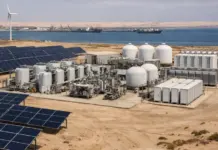
agreed that a very broad cooperation that has suitable partner countries will have to be part of this equation. He put stress on a hydrogen alliance with Morocco, which also includes plans for the construction of a green hydrogen plant in the African nation, which would be the first of its kind on the continent.
The project is to showcase that green hydrogen can be produced in a competitively efficient and viable way. Once operational, the facility will go on to reduce CO2 emissions by 100,000 tons per year.
Apart from the €7 billion that has been allocated for green hydrogen in Germany, the government stimulus also has a further €2 billion in order to create partnerships with other nations.
Opines Agora’s Schäfer that ” We need a European collaboration on hydrogen, which, when combined with the renewables capacity of countries in the European south, could help Germany achieve its renewables requirements.”
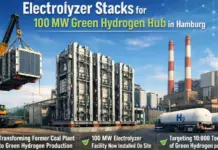
In the meantime, German states have already started to see the new green hydrogen facilities cropping up. The northern city-state of Hamburg, for instance, has announced plans in September to become home to the largest hydrogen electrolysis plant in Germany with a capacity of around 100 megawatts.
The southern state of Bavaria, on the other hand, has gone on to set up a hydrogen research center and has already roped in Audi and BMW, along with Siemens and also Bayernwerk, the energy supplier.
Announcement of the Hydrogen Grid
German gas pipeline operators, earlier in 2020, had revealed the blueprint for the largest hydrogen grid in the world, which would go on to cover almost 5900 kilometers or 3666 miles.
Details related to the first section, when it gets ready in 2030, are going to be around 1,200 kilometers in length and were released in July 2020.
Interestingly, only 100 kilometers of the first stage would have to be constructed, with the remaining being converted former gas pipelines, as per the grid operations’ association FNB Gas.
According to FNB Gas, the H2 Startnetz 2030 would indeed enable around 30 specific green gas projects, which have been identified in northern Germany, so as to connect with major areas for green hydrogen demand in North Rhine-Westphalia as well as Lower Saxony states. The network is anticipated to cost €660 million and will in the end link to the Netherlands, which looks forward to having 30%-50% of its energy produced via decarbonized gas by 2050.
In spite of the hype created around green hydrogen, in 2019, a report from the International Renewable Energy Agency – Irena warned that the fuel “should not be regarded as a panacea.” It remarked that hydrogen would still most certainly trail other strategies when it comes to carbon-free energy because of the cost of production associated with it and is going to have very pinpointed applications.