








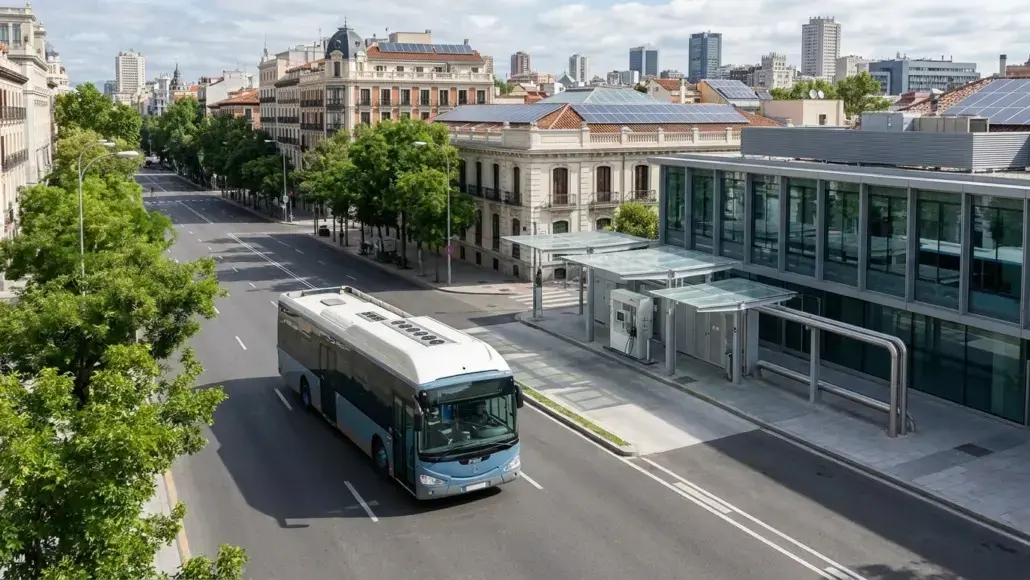

European public transport is coming under increasing pressure. The EU has called for a 90% reduction in carbon emissions from city buses by 2030, and public transport operators are looking for dependable, emissions-free alternatives. With this objective, a pilot test is now being launched in Madrid – for the last few weeks, an Irizar bus has been taking passengers around the Spanish capital, which is powered by a Bosch fuel cell power module – FCPM.
The vehicle will operate on routes where the long range of the fuel cell can be fully utilized to illustrate its advantages. The operator is Alsa, which is a Spanish bus company.
According to the member of the Bosch Mobility sector board and president of Bosch Power Solutions, Thomas Pauer, “The fuel cell is the perfect complement to battery-electric powertrains – even in bus operations. Fuel cells are especially well-suited for buses that travel longer distances every day and rarely have the opportunity to charge en route. With this trial, we can clearly demonstrate that Bosch’s fuel-cell technology is ready for the demands of large-scale deployment in passenger transport.”
It is worth noting that the test vehicle has been thoroughly tested in the last weeks and obtained the required approval. Now the durability and performance of the fuel-cell powertrain in real working conditions day-to-day will be checked. The test bus is fitted with a Bosch fuel cell power module C190 fuel-cell system.
This compact system, which is built around a horizontal double stack, produces a constant output of 190 kilowatts. The existing hydrogen tank capacity allows for ranges exceeding 1,000 kilometers with refuelling times of only 10 to 15 minutes. It also allows the bus to be utilised for intercity service. Besides the FCPM C190, Bosch also manufactures the FCPM C300, a system intended for heavy tour buses as well as trucks. And rounding off the range is the FCPM C100. Its flat design and uninterrupted power output of 100 kilowatts make it the perfect solution for city buses.
The EU rules are pushing the bus industry to innovate
EU regulations are forcing bus operators along with city transit companies to seek alternative options to diesel engines. Besides regulations for better air quality within cities, climate regulations further call for more sustainable powertrain systems. For instance, new city buses need to lower carbon emissions by 90% from 2019 levels by 2030, with all other buses needing to do so by 2040. Vehicles with fuel cell power modules that the EU classifies as zero-emission vehicles can play a major part in this regard. The European Automobile Manufacturers’ Association – ACEA said more than 38,000 new buses had been registered in the EU in 2025.
Bosch technology throughout the whole hydrogen value chain
Bosch strongly supports the development of an H2 economy and works on technical approaches for the production, infrastructure and utilisation of hydrogen. In 2025, the organization announced the commercial launch of its Hybrion PEM electrolyzer stack for producing hydrogen. Bosch is also developing technology for hydrogen engines and delivers the right components when it comes to port and direct injection. By 2025 end, a team of developers from Bosch received the German Future Prize, which is the federal president’s award in terms of technology and innovation, for the development of the mobile fuel cell.