















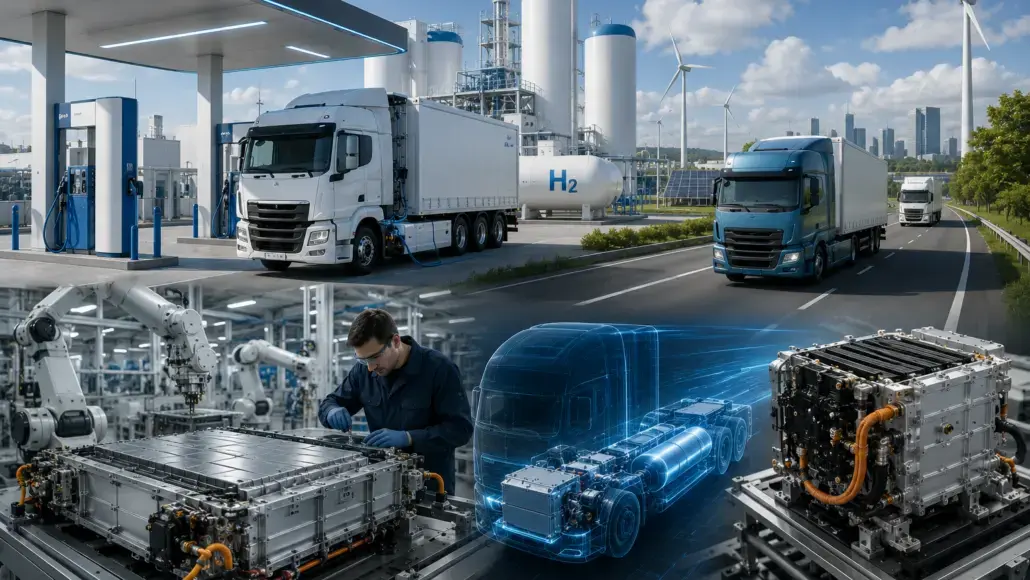

Toyota Motor Corporation, Volvo Group as well as Daimler Truck, the global automotive manufacturers, have entered into a legally binding contract to strengthen their partnership on hydrogen-powered transport and see Toyota become a proportionate shareholder in cellcentric, which is their fuel cell technology joint venture.
The deal is an important turning point in the global effort to decarbonize heavy-duty transport, bolstering one of the most ambitious collaborations of the industry when it comes to the development of hydrogen fuel cell systems for commercial vehicles.
It conforms to a non-binding MOU signed earlier in 2026 and is contingent upon regulatory approval before the deal is scheduled to close around the end of 2026 or early 2027.
Following the deal, Toyota will be a one-third shareholder on equal terms compared with Volvo Group and Daimler Truck in cellcentric – a company created by Volvo and Daimler Truck in 2021 to speed up the commercialization of hydrogen fuel cell technology as far as heavy-duty applications are concerned.
The companies said the alliance would bolster the technological leadership of cellcentric, expand industrial scale, and enhance its competitive edge as demand for zero-emission transport solutions increases.
The alliance draws on the complementary advantages of the three makers.
Volvo Group and Daimler Truck have a broad background in designing and manufacturing commercial vehicles, and Toyota has over 30 years of research and development experience in hydrogen fuel cell technology, which includes passenger cars like the Mirai.
The companies are collaborating to speed up the development, production, and commercialization of hydrogen fuel cell systems intended for heavy-duty trucks as well as other applications in which battery electric technology encounters real-world challenges.
Unlike vehicles powered by batteries, hydrogen fuel cell vehicles produce power from an electrochemical reaction that happens between hydrogen and oxygen, with water vapor being the only by-product.
The technology is seen as particularly suitable for long-haul trucking due to its shorter refueling times, less total vehicle weight, and longer driving ranges than traditional battery-electric systems.
cellcentric is going to continue to be an independent company catering to a broad spectrum of customers in heavy-duty on-road and off-road transport as well as offering fuel cell systems for coaches, stationary power generation, rail applications, and also heavy industrial equipment.
All the three parent companies said they were going to continue to compete in every other aspect of their businesses and that the joint venture would be limited to fuel cell technology.
The investment from Toyota is anticipated to improve capabilities of cellcentric through several key areas, such as the development of fuel cell unit cells, which serve as the basic building blocks of hydrogen fuel cell stacks, in addition to system integration, manufacturing processes, and control architecture.
The companies say more collaboration is needed to help reduce the cost of production and achieve the economies of scale necessary to make hydrogen-powered transport commercially viable.
Beyond developing technology, the partners plan to collaborate with governments, industry groups, and companies throughout the hydrogen value chain to speed up the deployment of hydrogen infrastructure.
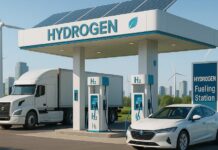
One of the major barriers to the wider use of hydrogen-powered commercial vehicles is the absence of large-scale hydrogen production infrastructure and transportation networks as well as refuelling facilities. Through contributing to the wider hydrogen ecosystem, the companies aim to lay the groundwork for the technology to reach mass-market adoption.
Cellcentric already staffs over 560 specialists in Germany as well as Canada and has set up a large portfolio of intellectual property in the form of approximately 700 patents for its fuel cell technologies. The company seeks to be one of the preeminent tier-one suppliers of hydrogen fuel cell systems in the world as far as commercial transportation is concerned.
The announcement follows a global increase in government action to curb emissions coming from transport, which is one of the largest sources of greenhouse gas emissions. Heavy-duty freight remains one of the hardest sectors to decarbonize due to the demanding operating requirements that are placed on long-haul trucks.