






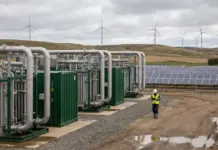


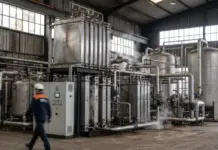





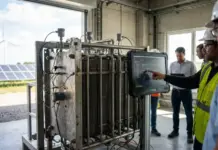






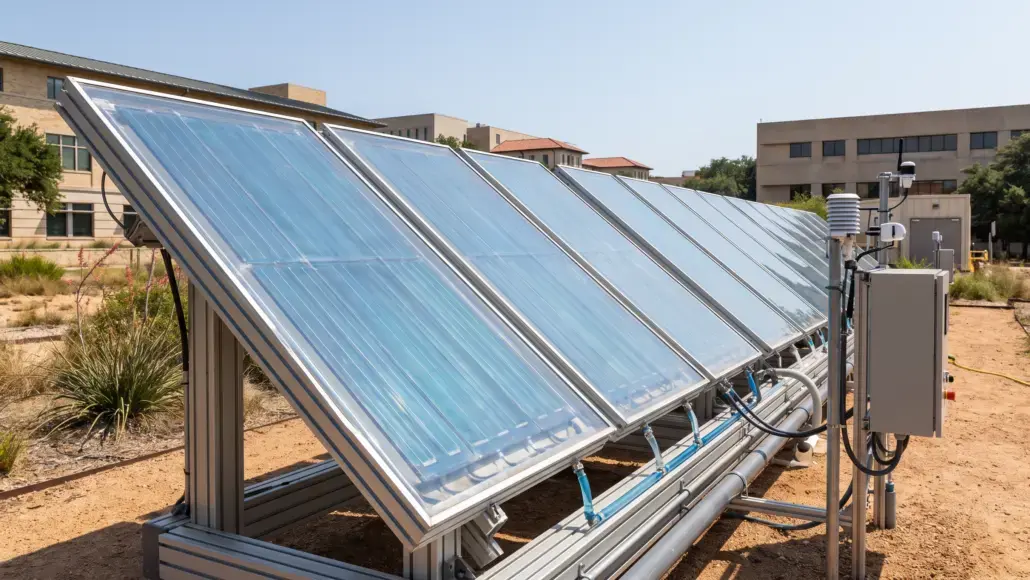

SunHydrogen, Inc., which is a developer of a revolutionary technology that generates renewable hydrogen using just sunlight and water, on July 15, 2026, revealed the deployment of upgraded 1.92 m2 hydrogen modules at the pilot demonstration system of the company at the University of Texas at Austin’s Hydrogen ProtoHub.
It is worth noting that the newly installed modules contain a number of engineering enhancements that have been identified during preliminary outdoor testing, which include a revised reactor housing so as to accommodate inclined operation, better catalyst fusion, and enhanced protective coatings, as well as wider instrumentation. The upgrades are part of the staged pilot program by SunHydrogen in order to validate module performance along with manufacturability, as well as system dependability under real-life operating conditions.
The modified reactor housings are configured to operate at a fixed tilt of about 30°, near the latitude of Austin, to provide a feasible solar field configuration for assessing all year-round sunlight capture along with outdoor performance. The inclination is also aimed at enabling additional enhancements in the gas collection and separation in the reactor housing. Future commercial installations could be mounted at various angles based on geographic location, site limitations, structural layout, and project specifications.
By operating upgraded 1.92 m2 hydrogen modules in parallel with previous generation units, SunHydrogen is able to directly assess performance, endurance, and operating attributes under comparable outdoor conditions. The results will feed into the design of future modules, manufacturing methods, and system architecture.
Temperature is still a major engineering priority of the Austin pilot. While testing in the lab enables tight control of temperature and standard lighting, outdoor operation subjects the system to the constantly shifting sunlight, ambient conditions, and winds at all times of the day and throughout the seasons.
Various components of the reactor respond distinctly to temperature changes. Higher temperatures tend to lower the voltage level of a semiconductor but often enhance the response kinetics of a catalyst. The aim, then, is not to maximize or minimize operating temperature but to broaden the practical operating window over which the semiconductor absorber, protective coatings, catalysts, gas management system as well as balance of system components work together with the highest efficiency and dependability. The data from the Austin pilot project will be used to optimize future designs of reactors for outdoor usage over long periods.
SunHydrogen has also improved the instrumentation and tracking capabilities of the Austin pilot. Improved sensing and data-acquisition systems offer more insight into the performance of a reactor, involving gas composition measurement to determine hydrogen production in real-world conditions, and permit higher-confidence evaluation of long-term outdoor operation.
According to Dr. Syed Mubeen, Chief Technology Officer of SunHydrogen, “A pilot system reveals what laboratory testing cannot. The upgraded 1.92 m2 hydrogen modules reflect the lessons from our initial field deployment and bring us another step closer to a durable, manufacturable technology for real-world hydrogen production.”
Separately, more upgraded semiconductor modules from the manufacturing-development program of SunHydrogen with CTF Solar have come to the Iowa facilities of the company.
Apparently, these modules are going to be used to assess manufacturing reproducibility, production output, and also performance in the field on a larger population of manufactured modules.
This evaluation goes on to cover the uniformity as well as repeatability of protective coatings due to production runs. The work aims to show that recent design advances can be made reliably and better be translated into scalable manufacturing processes. Says the CEO of SunHydrogen, Tim Young, “Our pilot program is about more than validating performance,” said Tim Young, CEO of SunHydrogen. “It is about building the engineering and manufacturing foundation needed to move our technology from successful prototypes toward commercial deployment.”
Notably, SunHydrogen is going to collect long-term operational data from the Austin test pilot over the coming months. The program’s findings will feed into the next generation of module design, manufacturing procedures, integration of systems, and standard architecture as the company progresses in the direction of larger-scale field demonstrations as well as commercial execution.