

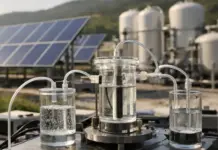
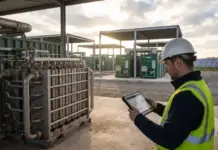


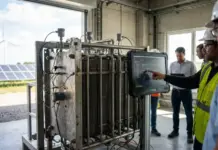
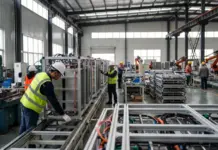

The development of hydrogen technologies provides great opportunities for value creation, industrial development and jobs in eastern Germany. A new study by the Initiative for Hydrogen in Eastern Germany – IWO carried out by the WifOR Institute and the Fraunhofer Institute for Solar Energy Systems ISE shows: The production of electrolysers and the corresponding supply chain in eastern Germany could create an annual gross value added of up to 2.2 billion euros by 2045.
According to Dominik Härle, Executive Director of the Initiative for Hydrogen in Eastern Germany, “The study shows that the economic opportunities of the hydrogen economy extend far beyond the production and use of hydrogen. It is precisely the manufacture of the technologies required for this that opens up new potential for industrial value creation and employment in Eastern Germany.”
Industrial Value Creation Is the Goal
The results draw attention to an aspect of the hydrogen economy which has so far received little attention: the industrial manufacturing of electrolyzers and the associated potential for value creation and job creation. Therefore, the IWO is developing a new perspective on the hydrogen economy from an industrial policy standpoint. The economic opportunity is not just in making the hydrogen but in exporting the technologies to make the global ramp-up of hydrogen happen in the first place. Electrolysers comprise a large number of components and intermediate products. Their expansion thus benefits not only the electrolyzer manufacturers themselves but also companies in the mechanical engineering, metalworking and electrical industries. This is particularly the case for eastern Germany.
Dr. Tom Smolinka, head of the Membrane Electrolysis Department at Fraunhofer ISE, says, “Building a hydrogen economy doesn’t start with hydrogen production. It starts with the technologies that enable the hydrogen ramp-up. The manufacture of electrolyzers combines research, innovation, and industrial production in a unique way.”
Thus, the scenarios for 2045 show a gross value-added potential for Eastern Germany of between 480 million and 2.2 billion euros. Thus, the baseline scenario corresponds to the current level of production of paper and paper products in eastern Germany, which is at about 1.4 billion euros. This amounts to 2.2 billion euros, the gross value added from coking and petroleum processing today. The economic potential reaches far beyond the electrolyser manufacturers. How much value-added will remain in eastern Germany will depend very much on the involvement of regional suppliers. In addition, the production of electrolyzers requires, among other things, metal products, electronic products, electrical equipment, machinery, and chemical and material-related intermediate inputs.
This economic development also has great employment potential. The employment effect for 2045 is estimated to be around 12,570 people in the baseline scenario. Of the projected 12,570 jobs, approximately 8,080 would be employed by electrolyzer manufacturers and 4,490 in East German supply chains. Depending on the market scenario, the range is somewhere between 4,300 and 20,000 people. Skilled labour makes up 58% of the effect, while experts and specialists make up a further 30% or so.
As per Florian Fickler, team lead for labor market research at the WifOR Institute, “The study makes it clear that it is not only electrolyzer manufacturers who benefit from a growing hydrogen economy. Value creation and employment are generated along the entire supply chain. Particularly noteworthy is the high proportion of skilled jobs, which are of great importance for the industrial transformation of eastern Germany.”
Value creation occurs at the point of technology production
The study clearly shows that the economic opportunities of the hydrogen economy are much broader than the production and use of hydrogen. In particular, value is added where technologies for the hydrogen ramp-up are developed, produced and integrated into industrial value creation using regional supply chains.
The development of hydrogen technologies allows eastern Germany to build upon its existing industrial and technological strengths in a future market that is growing worldwide. The results also reveal that the choice of location for production and supply has a significant impact on value creation and employment at the same time. A major part of the economic impact happens along the supply chains and therefore where industrial manufacturing takes place.
“The study shows that the hydrogen ramp-up is associated with significant industrial value-added and employment effects. Where electrolyzers and their components are produced plays a key role in determining where value creation and jobs are generated. If Germany and Europe rely on a strong industrial base when building the hydrogen economy, this will benefit not only technological sovereignty and security of supply but also value creation and jobs,” says Dominik Härle.
Two Known Experts
The study was carried out by two renowned experts commissioned by the IWO: the WifOR Institute and the Fraunhofer Institute for Solar Energy Systems ISE.
The WifOR Institute is an independent economic research institute with a focus on macroeconomic analysis. In the labour market area, it analyses the economic and employment effects of transformations, from value added and employment effects to skills requirements and strategic implications for labour market, industrial and economic policy.
The Fraunhofer ISE in Freiburg is one of Europe’s leading research institutes for renewable energy. Here scientists are developing technical solutions for the entire hydrogen value chain – from materials research to the development and optimization of electrolysis processes to system integration into energy infrastructure.
Hydrogen – Eastern Germany Joins Forces
Initiative for Hydrogen in Eastern Germany e.V. – IWO is the joint platform of the six federal states of eastern Germany for the cross-state development of the hydrogen economy. It brings together the regional know-how and strengths of Berlin, Brandenburg, Mecklenburg-Western Pomerania, Saxony, Saxony-Anhalt and Thuringia. The initiative is supported by the federal government as a network partner.
The IWO was founded by a resolution of the 2022 Conference of Minister Presidents of Eastern Germany. This was based on the Riemser Declaration, which said – Eastern Germany has strengths that can complement each other in the implementation of a hydrogen ramp-up along the entire value chain. Efficient cooperation across states can lead to synergies and cost reductions.
In this respect, the mission of the IWO is to harness existing opportunities and potential and to position Eastern Germany as a key region for the hydrogen economy. The IWO brings together stakeholders from politics, business, academia and government and promotes cross-regional cooperation of all its members. One of the main goals is to enhance the framework conditions for hydrogen projects.