



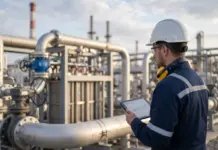
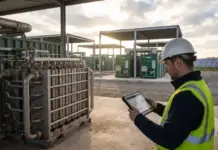







As the global community accelerates its transition toward a hydrogen-based energy system, the physical security and operational safety of hydrogen production facilities have become paramount. Hydrogen is a versatile and clean energy carrier, but it possesses unique physical characteristics that make it inherently difficult to manage. It has the highest diffusivity of any gas, a wide flammability range, and low ignition energy. Furthermore, hydrogen flames are nearly invisible to the naked eye, and the gas itself is odorless and colorless. In this challenging environment, traditional safety measures are often insufficient. AI Hydrogen Plant Safety has emerged as the definitive solution, utilizing advanced algorithms to provide a comprehensive, multi-layered defense against leaks, fires, and structural failures.
The integration of artificial intelligence into safety protocols represents a fundamental shift from reactive monitoring to proactive, intelligent vigilance. Traditional gas detectors often have slow response times and can be prone to false alarms caused by environmental factors like wind or humidity. AI-driven systems, however, utilize complex data fusion techniques to analyze inputs from a variety of sensors simultaneously. By identifying the specific patterns associated with a hydrogen leak or an incipient flame, these systems can trigger emergency responses with a speed and accuracy that far exceeds human capabilities. This transition is not merely an incremental improvement; it is the foundation upon which a safe and scalable hydrogen economy is being built.
The Challenge of Invisible Hazards and Diffuse Leaks
To understand the value of AI Hydrogen Plant Safety, one must first appreciate the specific dangers posed by hydrogen. Because hydrogen molecules are so small, they can leak through seals and materials that are perfectly adequate for natural gas. Once released, hydrogen rises rapidly, potentially accumulating in high, poorly ventilated areas where it can form explosive mixtures. The primary safety goal in any hydrogen plant is the immediate detection and localization of these leaks. However, in a large, noisy industrial facility, a small, high-pressure leak can be extremely difficult to find using conventional methods.
Artificial intelligence addresses this by processing data from ultrasonic and acoustic emission sensors. When gas escapes through a tiny orifice at high pressure, it generates a unique acoustic signature that extends into the ultrasonic range. AI models, trained on thousands of hours of plant noise and simulated leak sounds, can distinguish the “hiss” of a hydrogen leak from the background hum of compressors and pumps. This allows for the detection of leaks that are too small to trigger conventional chemical sensors, providing plant operators with the early warning needed to isolate the affected section before a hazardous volume of gas can accumulate.
Multi-Modal Sensor Fusion for Robust Monitoring
A core pillar of AI Hydrogen Plant Safety is the concept of multi-modal sensor fusion. A single type of sensor, no matter how advanced, can always be fooled. A chemical sensor might be blocked by dust, while an acoustic sensor might be overwhelmed by a sudden mechanical vibration. AI systems solve this by cross-referencing data from multiple sources. For example, if an acoustic sensor detects a possible leak, the AI immediately checks the local gas concentration sensors and thermal cameras in that specific zone to confirm the event.
This redundancy is handled by sophisticated machine learning algorithms that weigh the reliability of each input based on current environmental conditions. If the wind is high, the AI might prioritize acoustic data over gas concentration readings, which could be dispersed by the breeze. By creating a unified “safety picture” of the plant, AI-driven systems drastically reduce the rate of false positives while ensuring that true threats are never missed. This reliability is essential for maintaining operational continuity and preventing the costly shutdowns that result from nuisance alarms.
Advanced Computer Vision for Invisible Flame Detection
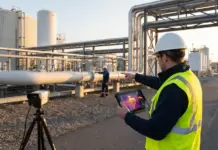
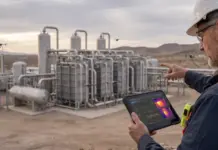
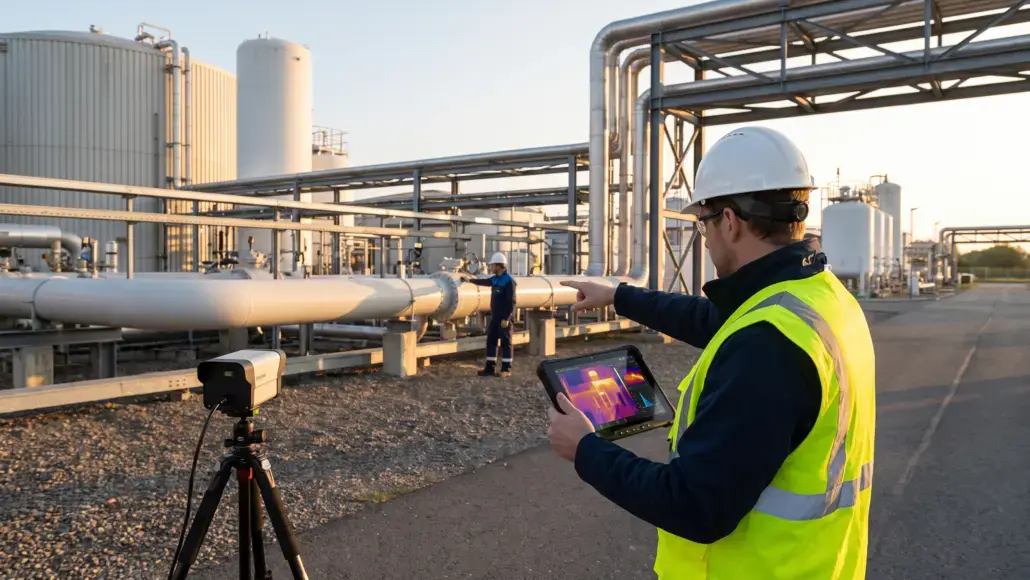
One of the most terrifying aspects of a hydrogen fire is its invisibility. A hydrogen flame emits very little visible light, making it almost impossible for human personnel to see in daylight. This can lead to catastrophic situations where workers unknowingly walk into a fire zone. AI Hydrogen Plant Safety utilizes advanced computer vision and thermal imaging to solve this problem. Thermal cameras sensitive to the specific infrared signatures of hydrogen combustion are coupled with AI models that can distinguish between a real fire and a reflection from a hot surface or the sun.
These AI-enhanced vision systems do more than just detect the presence of a flame; they can also track its size, direction, and intensity in real-time. This information is instantly relayed to the plant’s automated fire suppression systems and emergency responders. By providing an “eye” that can see the invisible, AI ensures that fire hazards are contained in their earliest stages. Furthermore, these systems can be integrated into wearable devices for plant technicians, providing them with augmented reality (AR) alerts that highlight fire zones and safe evacuation routes, significantly enhancing personal safety in the field.
Predictive Risk Assessment and Structural Integrity
Safety in a hydrogen plant extends beyond just detecting leaks; it involves understanding the long-term health of the physical infrastructure. Hydrogen embrittlement is a major concern, where hydrogen atoms penetrate the crystalline structure of metals, making them brittle and prone to sudden, catastrophic cracking. AI Hydrogen Plant Safety incorporates predictive analytics to monitor the cumulative exposure of pipes, tanks, and valves to high-pressure hydrogen. By analyzing data from strain gauges and ultrasonic thickness monitors, AI can predict when a component is approaching a critical state of embrittlement.
This predictive approach allows for “preventative safety,” where components are replaced before they have a chance to fail. The AI models can simulate the stress distribution across the entire facility, identifying specific “hot spots” where the combination of pressure, temperature, and material age creates the highest risk of failure. This level of granular risk assessment is a quantum leap over traditional safety inspections, which are often limited to visual checks and periodic pressure tests. By treating safety as a dynamic, data-driven process, AI ensures that the physical integrity of the plant is maintained at the highest possible standard throughout its entire lifecycle.
Autonomous Emergency Response and Isolation Protocols
In the event of a confirmed safety breach, every second counts. AI Hydrogen Plant Safety is increasingly being integrated with autonomous control systems that can initiate immediate isolation protocols without waiting for human intervention. If the AI detects a high-pressure leak in a specific piping manifold, it can instantly command the automated valves to close, segmenting the plant and limiting the volume of gas released. Simultaneously, the AI can adjust the ventilation systems to maximum power and divert electrical current away from the affected area to prevent potential ignition sources.
These autonomous responses are governed by a complex set of safety rules that the AI has learned through thousands of simulated emergency scenarios. This ensures that the response is not only fast but also correct for the specific situation. For example, the AI might determine that a full plant shutdown is unnecessary and that only a single production line needs to be isolated, maintaining as much production as possible while ensuring total safety. This precision in emergency management minimizes the economic impact of safety incidents while providing a level of protection that manual systems simply cannot match.
The Role of Digital Twins in Safety Training and Simulation
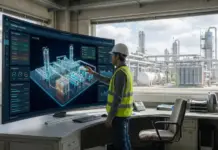
The synergy between AI Hydrogen Plant Safety and Digital Twin technology provides a powerful tool for workforce training and safety planning. A Digital Twin allows safety officers to simulate a wide range of hazardous scenarios from a minor leak to a major vessel rupture in a completely safe virtual environment. AI models within the twin can predict how a gas cloud will disperse based on real-time weather data and the specific topography of the plant. This information is used to design the most effective locations for sensors and the most efficient evacuation routes.
Technicians can use VR headsets connected to the Digital Twin to practice their response to these simulated emergencies. The AI monitors their actions, providing feedback on their response time and adherence to safety protocols. This “experiential” training ensures that the plant personnel are intimately familiar with the facility’s safety systems and are prepared to act decisively in a real-world crisis. By the time a worker enters the physical plant, they have already “lived through” dozens of emergency scenarios, making them a vital part of the facility’s overall safety culture.
Regulatory Compliance and the Future of Zero-Incident Production
As the hydrogen industry scales, regulatory bodies around the world are implementing stricter safety standards. AI Hydrogen Plant Safety facilitates seamless compliance by maintaining a detailed, tamper-proof record of every safety-related event, sensor reading, and maintenance action. This “digital audit trail” provides regulators with the evidence they need to verify that a facility is operating safely and in accordance with the law. For plant operators, this transparency reduces the risk of fines and legal liability, while also fostering trust with the local community and investors.
The ultimate goal of integrating AI into hydrogen safety is the achievement of a “zero-incident” production environment. While no industrial process can be entirely risk-free, the combination of multi-modal sensing, predictive analytics, and autonomous response brings us closer to that ideal than ever before. As AI models continue to learn from more diverse datasets and as sensor technology becomes even more sensitive, the safety net surrounding hydrogen plants will only become stronger. In this future, the clean energy promise of hydrogen will be fulfilled not just by its lack of carbon emissions, but by the intelligence and reliability of the systems that produce it.
Continuous Learning and the Global Safety Network
One of the most powerful features of AI is its ability to learn from experience. In a global safety network, anonymized data from safety incidents and “near-misses” at one plant can be used to update the AI models at all other plants. This means that a lesson learned at a facility in North America can immediately improve the safety protocols of a plant in Asia. This collective intelligence accelerates the maturation of the entire hydrogen industry, ensuring that safety standards evolve at the same rapid pace as the technology itself.
The future of AI Hydrogen Plant Safety is one of total, intelligent integration. We are moving toward a reality where the plant itself is “aware” of its own health and the safety of the environment around it. This self-monitoring capability will be the defining characteristic of the next generation of hydrogen infrastructure, providing the peace of mind needed to integrate this critical clean fuel into every aspect of our global energy system. By placing artificial intelligence at the heart of our safety strategy, we are ensuring that the hydrogen transition is as safe as it is sustainable.