

























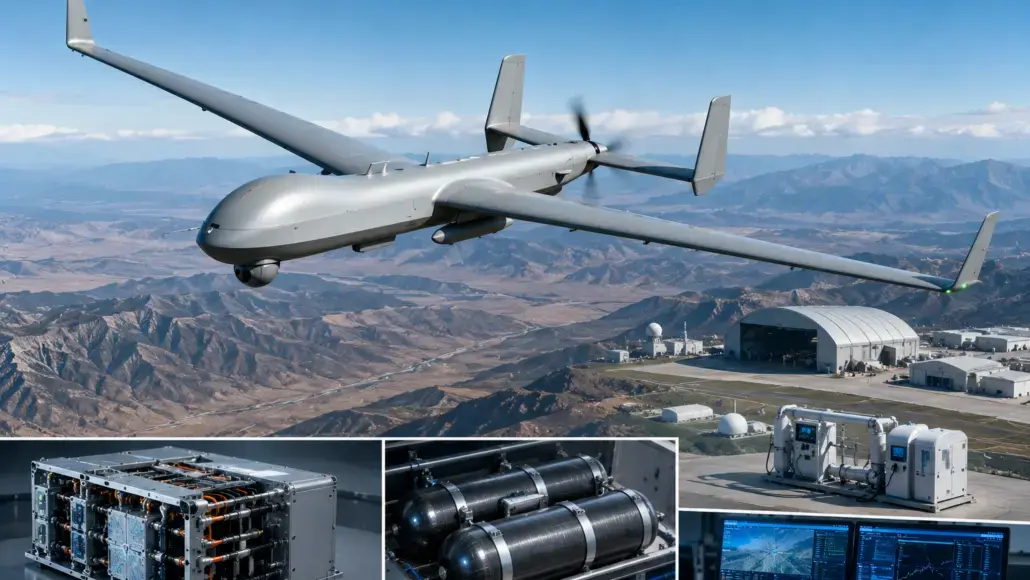

Intelligent Energy has launched a new 120kW hydrogen fuel cell power system related to heavy-lift fixed-wing drones and has won its biggest commercial order so far in the Uncrewed Aerial Vehicle – UAV sector.
The two breakthroughs come as the UAV business of the hydrogen fuel cell manufacturers continues to expand, with consumer demand increasingly for hydrogen-powered drones that can fly greater distances, carry larger payloads, and stay in the air for longer periods compared to battery-powered alternatives.
The new system is designed to fulfill the need for long-range, fixed-wing UAVs that are capable of transporting payloads ranging from 150 kg to 750 kg for routine surveillance, defence, security as well as logistics operations.
The 120kW hydrogen fuel cell power system, identified as IE-FLIGHT™ 120, is the most recent addition to Intelligent Energy’s IE-FLIGHT™ family of aerospace fuel cell product lines. It sits between the existing IE-SOAR™ systems of the company for which it has won the record contract and the higher-power fuel cell technology in development pertaining to electric vertical takeoff and landing aircraft as well as regional aviation.
The developments follow the commitment made by the UK government to make investments of £5 billion in drones and autonomous systems as part of its Defence Investment Plan, backing the goal to grow the domestic drone industry of the UK. They also indicate the growing commercialization of hydrogen fuel cells as far as UAV applications are concerned.
Intelligent Energy says its fuel cells could run flights three to five times longer compared to the flights of battery-powered planes, with emissions of merely water vapor. The technology also offers lower vibration and noise levels, decreased maintenance needs, and a reduced thermal signature when compared with conventional combustion engines, which makes it especially appropriate for monitoring, defence and security tasks.
Interestingly, Intelligent Energy was awarded £17m from the HEIGHTS programme which is Aerospace Technology Institute-backed, in 2026 so as to speed up the development of its high-power aviation fuel cell systems. The company also made an investment in a new high-power fuel cell test centre at Northamptonshire’s Chelveston so as to support the next phase of development.
According to the Chief Commercial Officer at Intelligent Energy, Greg Harris, “The UAV market is moving rapidly towards larger aircraft that need to fly further, carry heavier payloads, and stay airborne for much longer. That’s where hydrogen fuel cells have a clear advantage. Our new fixed-wing power system demonstrates how our fuel cell technology can scale to an entirely new class of aircraft. It builds on the same platform we’re developing for larger aircraft and shows how hydrogen can unlock new capability across both the UAV and aerospace sectors. Combined with a record order for our IE-SOAR technology, this launch underlines a clear trend in the market. Operators are increasingly turning to hydrogen propulsion to achieve longer endurance, greater payload capacity, and improved mission capability.”