


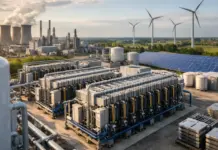

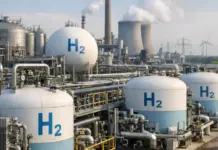

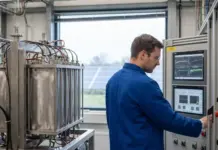
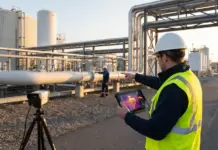

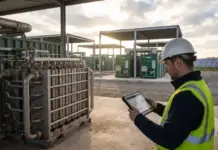
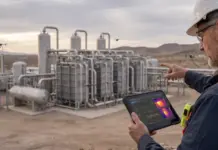







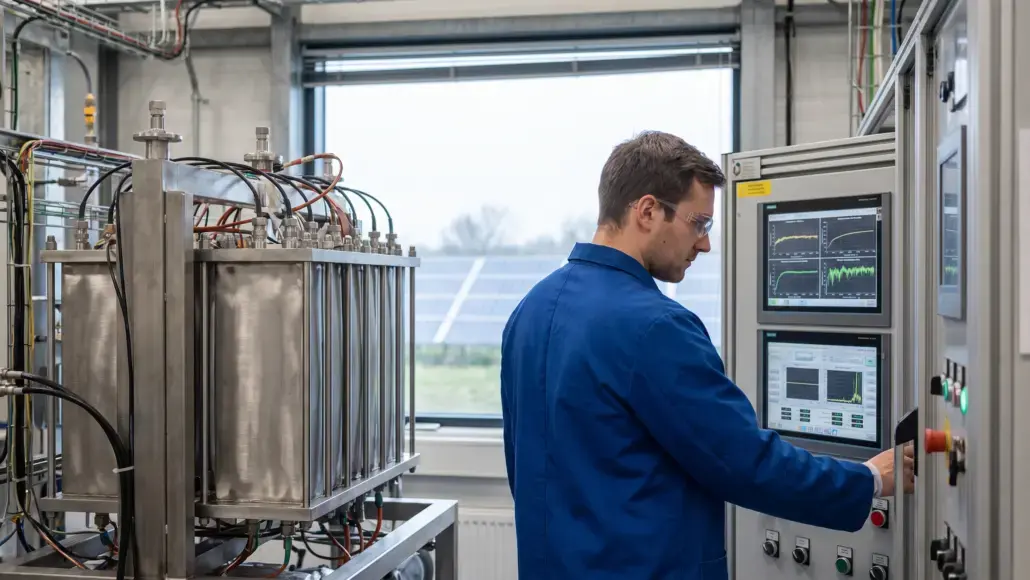

The global industrial landscape is undergoing a significant transformation, driven by the need for sustainable energy solutions and the rapid advancement of digital technologies. At the forefront of this movement is the production of green hydrogen, a process that relies heavily on the efficient operation of water electrolyzers. However, the inherent complexity of electrolysis characterized by non-linear electrochemical reactions, fluctuating thermal dynamics, and sensitive pressure balances poses substantial challenges for traditional control systems. In response, AI-Based Process Control has emerged as a revolutionary approach, providing the intelligence and adaptability required to manage large-scale hydrogen production facilities with unprecedented precision.
Historically, industrial processes have relied on Proportional-Integral-Derivative (PID) controllers and basic supervisory systems. While effective for stable, steady-state operations, these classical methods often struggle with the dynamic and intermittent nature of renewable-powered hydrogen production. As wind and solar generation vary, the electrolyzer must rapidly adjust its load while maintaining safety and efficiency. AI-Based Process Control addresses these limitations by utilizing machine learning models that can predict system behavior and adapt control strategies in real-time. This transition from reactive to proactive, data-driven management is defining the next generation of smart hydrogen infrastructure.
Evolution from Classical Control to Intelligent Architectures
The shift toward AI-Based Process Control represents a fundamental change in how we perceive and manage industrial systems. Classical control theories are often based on simplified mathematical models of physical systems, which frequently fail to capture the high-frequency transients and complex interactions within an electrolyzer stack. For instance, the relationship between current density, temperature, and gas crossover is highly non-linear and time-varying. An AI system, however, can ingest vast amounts of historical and real-time data to “learn” these relationships, creating a much more accurate representation of the physical process.
Furthermore, intelligent architectures allow for the integration of disparate data sources. In a modern hydrogen plant, the control system is not just looking at the electrolyzer; it is also monitoring the purity of the feed water, the status of the cooling system, and the predicted output of the renewable energy farm. AI-Based Process Control acts as a central nervous system, orchestrating these components to achieve a global optimum. By utilizing neural networks and fuzzy logic, these systems can balance competing objectives, such as maximizing hydrogen output while minimizing energy consumption and equipment wear, in a way that is far beyond the capabilities of a human operator or a simple PID loop.
Implementing AI-Enhanced Model Predictive Control (MPC)
One of the most effective applications of artificial intelligence in this field is the enhancement of Model Predictive Control (MPC). MPC is an advanced control strategy that uses a process model to predict future system behavior and solve an optimization problem at each time step. When combined with AI, the “model” in MPC becomes a dynamic, self-learning entity. These AI-enhanced MPC systems can account for the degradation of membranes and electrodes over time, adjusting their control parameters to maintain performance even as the hardware ages.
In the context of green hydrogen, AI-Based Process Control using MPC is particularly valuable for managing power fluctuations. The controller can anticipate a sudden drop in solar power based on short-term weather forecasts and proactively scale down the electrolyzer’s power draw. This prevents the system from experiencing thermal shocks or gas purity issues that can occur during rapid shutdowns. By predicting the future trajectory of the process, the AI ensures that the plant always operates within its most efficient and safe thermal-pressure window, significantly improving the stability and reliability of the overall production system.
Surrogate Modeling for Real-Time Decision Support
A significant barrier to implementing complex AI models in real-time control is the computational intensity required. Large-scale physical simulations are often too slow for sub-second response times. To overcome this, engineers are using AI to create “surrogate models” compact, fast-running approximations of the full physical system. These models are trained on high-fidelity data from Digital Twins or laboratory experiments and can provide nearly instantaneous predictions of how the system will react to a change in input.
AI-Based Process Control leverages these surrogate models to perform thousands of “what-if” simulations in milliseconds. This allows the controller to evaluate multiple potential control actions and select the one that offers the best outcome. For example, if there is a sudden increase in gas pressure, the AI can use a surrogate model to determine the exact valve adjustments needed to stabilize the system without causing a safety trip. This capability for high-speed, intelligent reasoning is what makes AI-based systems so much more resilient than their traditional counterparts.
Adaptive Reinforcement Learning for Complex Dynamics
Beyond predictive modeling, the field of AI-Based Process Control is increasingly adopting Reinforcement Learning (RL) for adaptive control. RL is a type of machine learning where an agent learns to make decisions by interacting with an environment and receiving “rewards” for positive outcomes. In a hydrogen plant, the RL agent can be trained to optimize the operation of multi-stack electrolyzer systems, learning the best way to distribute the electrical load across different units based on their individual health and efficiency profiles.
The power of RL lies in its ability to handle extremely high-dimensional and non-linear problems. Unlike traditional control logic, which must be manually programmed, an RL agent discovers its own control laws through experience. This makes it exceptionally good at managing the “stochastic” elements of hydrogen production, such as variable gas demand or fluctuating electrolyte concentrations. As the system operates, the AI-Based Process Control continuously refines its strategy, becoming more effective and efficient over time. This self-improving nature is a hallmark of industrial AI, ensuring that the plant is always operating at the cutting edge of performance.
Synchronizing Balance-of-Plant and Auxiliary Systems
A hydrogen production facility is more than just an electrolyzer; it is a complex web of auxiliary systems including water deionization, gas purification, and high-pressure compression. AI-Based Process Control ensures that these peripheral components are perfectly synchronized with the core production process. For example, the gas compressors must operate in harmony with the electrolyzer output to avoid pressure spikes or energy waste. The AI system can modulate the compressor speed in real-time, matching the production rate and ensuring that gas is stored at the optimal pressure.
This level of synchronization also extends to thermal management. The heat generated during electrolysis can be recovered and used elsewhere in the plant, provided the flow rates are managed with precision. AI-Based Process Control uses thermal-fluid simulations to optimize the duty cycles of cooling pumps and heat exchangers. By treating the entire plant as a single, integrated system, the AI minimizes auxiliary power consumption and maximizes the overall energy efficiency of the facility. This holistic approach is essential for bringing the cost of green hydrogen down to parity with fossil-fuel-based alternatives.
Gas Purity and Safety Through Intelligent Monitoring
Safety is the absolute priority in hydrogen production, and AI-Based Process Control plays a vital role in maintaining the highest standards. One of the primary safety concerns is gas crossover the leakage of hydrogen into the oxygen stream or vice-versa. AI algorithms analyze gas purity data in real-time, correlating it with temperature and pressure profiles to detect the early signs of membrane failure. If a purity threshold is approached, the AI can initiate a controlled shutdown or adjust the differential pressure across the stack to mitigate the risk.
Furthermore, AI-based systems are far better at distinguishing between sensor noise and real operational anomalies. In traditional systems, a faulty sensor can lead to a “false trip,” causing unnecessary and expensive downtime. AI-Based Process Control uses cross-validation techniques comparing the readings from multiple sensors to ensure they are consistent with the physical laws of the process. This intelligent filtering reduces nuisance alarms while ensuring that real threats are identified and addressed immediately. The result is a plant that is both safer and more productive.
Economic Impact and Scalability in a Global Market
The integration of AI-Based Process Control is a fundamental driver of the hydrogen economy’s economic viability. By improving energy efficiency and reducing downtime, these systems can significantly lower the Levelized Cost of Hydrogen (LCOH). In a competitive global market, the ability to shave even 1% or 2% off the production cost can be the difference between a profitable project and a failed one. Moreover, the scalability provided by AI allows for the management of increasingly large and complex facilities, paving the way for the gigawatt-scale plants needed to meet climate targets.
Beyond cost savings, AI-driven control enhances the “bankability” of hydrogen projects. Investors and insurers are more likely to support facilities that can demonstrate a high level of operational stability and safety through AI-backed data. The transparent, data-driven nature of AI-Based Process Control provides a clear record of plant performance, reducing the perceived risk for all stakeholders. As we move toward a hydrogen-powered future, the role of artificial intelligence will only grow, serving as the essential foundation for a clean, efficient, and reliable energy system that can power the world for generations to come.
The Path Toward Fully Autonomous Hydrogen Facilities
As AI models continue to evolve and industrial data becomes more accessible, we are moving toward the concept of fully autonomous hydrogen production. In this future, AI-Based Process Control will not just assist human operators; it will be capable of managing the entire plant independently, from startup and production to maintenance and shutdown. These “dark” factories will be able to operate in remote locations, optimized for maximum output and minimum environmental impact without the need for a constant human presence.
This level of autonomy will be facilitated by the continuous integration of edge computing and high-speed communications. As AI systems become more decentralized, they will be able to respond to local changes with lightning speed, ensuring that the hydrogen supply remains stable even in the face of sudden disruptions. The journey toward this autonomous future is well underway, and AI-Based Process Control is the vehicle that will get us there. By embracing these intelligent systems today, we are ensuring that the world has the reliable, clean energy it needs to thrive in a post-carbon era.