






















ITACA and ITQ, researchers from Spain have developed materials to enhance hydrogen production from water by microwave radiation.
A team of the Institute of Chemical Technology – ITQ, a joint research center of the Universitat Politècnica de València – UPV and the Higher Council for Scientific Research – CSIC, and the Institute of Information and Communication Technologies – ITACA of the UPV, has gone ahead and developed the design of components allowing a way to enhance hydrogen production from water by microwave radiation. This process makes hydrogen available from renewable electric power and therefore prevents CO2 emissions from hydrogen production.
The research highlights a major advancement in the generation of green hydrogen by means of redox cycles, in which the material go on to absorb and release oxygen from the water, effectively separating it from oxygen. The design and use of materials that react to microwave radiation and that have these redox properties make it possible to generate green hydrogen from renewable electric energy. The transfer of electrons among atoms of various elements in the midst of the induced electromagnetic field is the foundation of the redox chemical cycle, which enables electrification of the procedure.
Interestingly, microwaves have unique perks in the electrification of a redox process – supply of electrical energy without the requirement of contacts and also a drastic reduction of the temperature of the cycle – from 1300 °C to 400 °C. This also simplifies the process of getting H2 and maximizes the energy efficiency.
Major innovation
The primary unique aspect of the work is a comprehensive examination of the properties of the material that influence the performance of the procedure. The fundamentals of the material design are set up to tailor the generation of oxygen and hydrogen and alter the energized state of the material depending on the intended application. It has also been shown that oxygen can be extracted by an extremely quick and highly controlled pulse process.
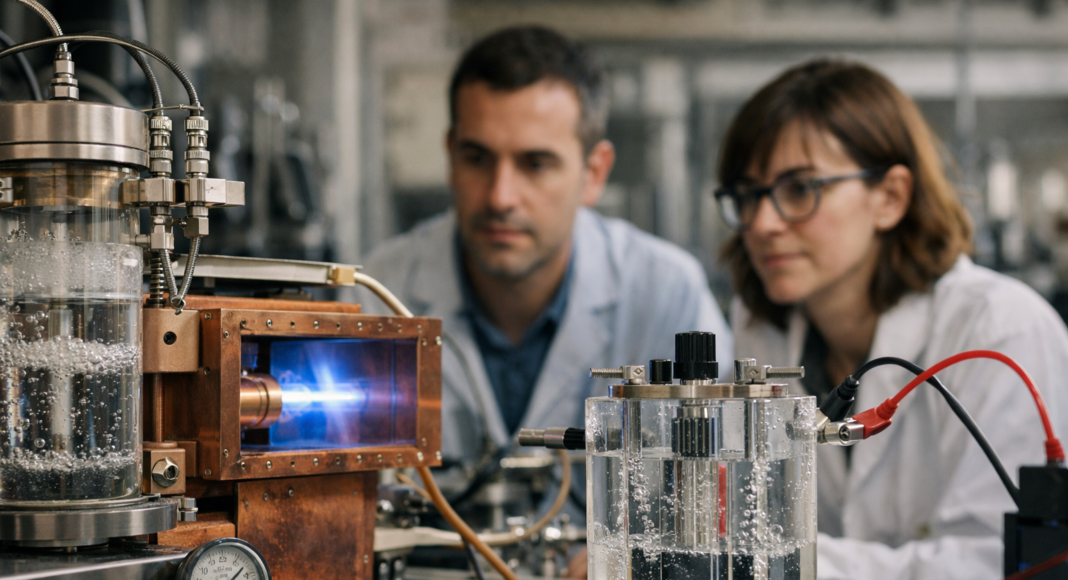
The structure of the cavities or chambers in which one applies microwaves and the control of the procedure of radiation on such materials is crucial in order to take full advantage of the special benefits provided by microwave technology.
Remarks director of the ITACA Institute UPV, Jose Manuel Catalá, “The design of the cavities or chambers where we apply microwaves, as well as the control of the radiation process on these materials, is essential to take advantage of the unique advantages offered by microwave technology. In recent years, this technology has been consolidated in numerous industrial applications due to its rapid scalability and high energy efficiency.
“During the research, a detailed study of the influence on hydrogen production of different dopants introduced into the matrix material (cerium oxide) has been made with the aim of adjusting the interaction with microwave radiation and the properties of the resulting energized material. Subsequently, the hydrogen production capacity of this material and the mechanism governing the process have been studied, which will facilitate the future design of materials,” says the director of the ITQ-UPV-CSIC.
The study, which has been published in the journal Advanced Energy Materials, demonstrated that the materials developed and utilized for better hydrogen production are robust and stable as well.
The project has received funding from the Ministry of Science, Innovation and Universities via European funds NextGenerationEU as well as Ramón y Cajal contracts along with the Generalitat Valenciana.