










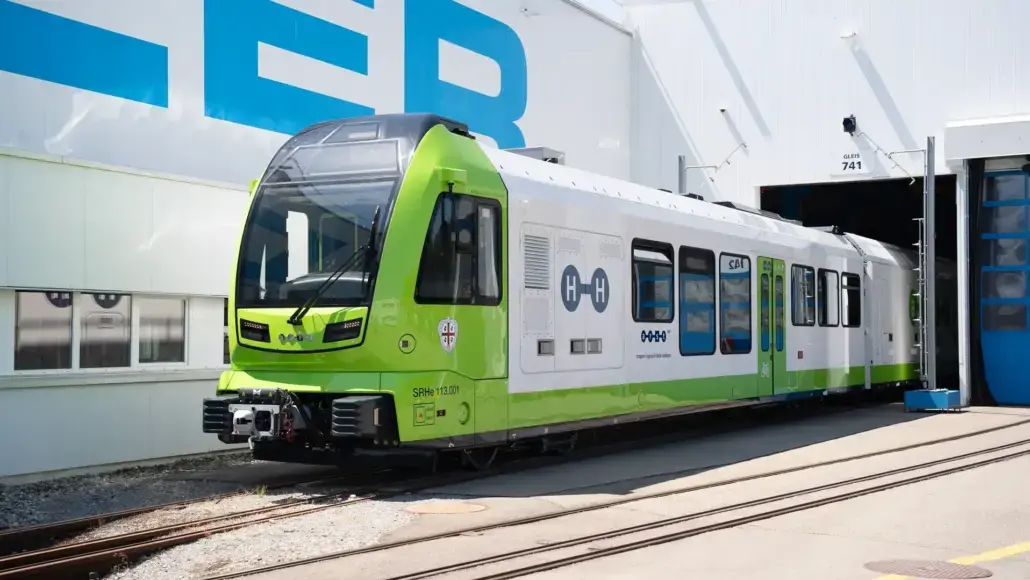

On 19 June 2026, Stadler and ARST – Trasporti Regionali della Sardegna demonstrated the World-first hydrogen-powered train for narrow-gauge lines in the world at the commissioning centre in Erlen. From 2028 the new Class SRHe 113 HMUs will go into passenger service on the lines run by ARST, including Alghero Airport – Mamuntanas, Sassari – Alghero and Sassari – Sorso.
With this launch of the first hydrogen-powered train for narrow-gauge in the world, Stadler and ARST are writing a fresh chapter in sustainable regional rail transport in the region of Sardinia. The ten HMUs will save more than 2,100 tonnes of CO₂ per year compared with diesel trains, which is equivalent to around 450 trips around the world by car.
Hydrogen made entirely from renewable energy
The innovation of these trains is in the way they are powered, with fuel cells as well as hydrogen tanks. The central car the Power Pack has a system which functions as a battery charger, transforming hydrogen into electrical energy so as to power and recharge the traction batteries.
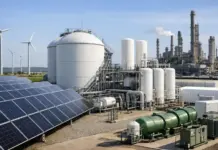
The energy for the hydrogen production is 100% derived from solar power. This is why the trains are powered by sustainable hydrogen fuel. The project aims at the development of a zero-emission system for narrow-gauge railway lines, right from energy generation to train propulsion.
According to the central director of ARST, Carlo Poledrini, “These vehicles, developed in collaboration with Stadler, are a central element of the decarbonisation strategy for the narrow-gauge network. It is the first step in ARST’s evolution from a transport operator to an energy company capable of powering its own network of services. As already demonstrated by the active construction sites in Mandas, Alghero and Macomer, we are integrating technological innovation in vehicles with the autonomous production of clean energy. Working in full synergy with regional institutions, ARST is bringing to fruition a model of sustainable and fully self-sufficient public transport.”
Crafted for narrow-gauge lines
Interestingly, when we talk of Italy, railways with narrow gauge tracks can only run trains having a very low axle load because of the special characteristics of the infrastructure. In order to meet this requirement, the new cars are designed in a unique profile and built with lightweight components so as to fully meet the specifications of the different lines.
Passengers will benefit from comfortable, air-conditioned, functional and light-filled interiors, complemented by large panoramic windows. The low entrance enables easy boarding even for persons having reduced mobility. The HMUs are more peaceful and generate less vibration than diesel trains, making the journey an even more enjoyable experience. Crew members will also have dedicated facilities such as a private access door as well as an independent air-conditioning system.
Class SRHe units will be subjected to a series of rigorous tests before entering service, conforming to the standards established by the Italian National Agency for the Safety of Railways and Road and Motorway Infrastructure ANSFISA.
Italian regions are turning towards sustainable rail transport.
The Framework Agreement signed between ARST and Stadler in 2023 offers the supply of a fleet of ten vehicles for regional and local transport in Sardinia. The project is a part of an initiative supported by the Italian government along with the Ministry of Infrastructure and Transport so as to decarbonize rail transport in Italy.
“The goal is to use hydrogen technology on narrow-gauge lines in order to create a completely new generation of modern and innovative, as well as sustainable, trains.
Alongside ARST, there are two other railway operators who are introducing more sustainable solutions using hydrogen technology developed by Stadler nine trains are being built for Ferrovie della Calabria – FdC and another two for Ferrovia Circumetnea FCE in Sicily. All vehicles are going to be manufactured at Bussnang.