







South Korea ramps up hydrogen power bids, bolstering the clean energy investment, development of infrastructure, and its long-term carbon neutrality targets.
It is worth noting that South Korea is vigorously chasing a strong hydrogen economy, kicking off major hydrogen power auctions in order to speed up its shift to a carbon-neutral tomorrow. These initiatives happen to be a core part of the country’s broader Hydrogen Economy Roadmap and are intended to position South Korea as a world leader in hydrogen technology and application.
As South Korea ramps up hydrogen power bids, one of the major milestones in this strategy was the launch of the first clean hydrogen power bidding market of the world in May 2024, with a first round of 6,500 GWh of bidding volume annually for 15 years, which is expected to enter commercial service in 2028. The first auction, however, was not very successful in December 2024, with just 750 GWh awarded from the offered quantity. This under-subscription was due to factors like high clean hydrogen import prices and no infrastructure. Only Korea Southern Power Company – KOSPO was effective in its bid to co-fire clean hydrogen – ammonia with coal.
In order to overcome these initial challenges, the 2025 hydrogen power bidding market was launched in May 2025. The new mechanisms introduced were aimed at encouraging involvement and mitigating risks. The 2025 auction is for 3,000 GWh/year of clean hydrogen power with 15-year contracts, to come online in 2029. There is also a general hydrogen power market with 1,300 GWh/year for 20-year agreements with production expected by 2027.
Importantly, the 2025 clean hydrogen auction has introduced a settlement system associated with the exchange rate and a hydrogen volume borrowing system, mitigating prior worries regarding the currency volatility risks for project developers.
There are a number of reasons behind aggressive push by South Korea on hydrogen. It is fuelled by a pledge to decarbonize and make the transition to a carbon-neutral economy by 2050, with the aim of substantially lowering greenhouse gas emissions and decreasing dependence on imported fossil fuels. The government regards hydrogen as a major growth engine, which it expects to generate 43 trillion won in economic gains and create 420,000 new jobs.
The Hydrogen Economy Promotion and Hydrogen Safety Management Law which has been in effect since 2021 sets out the legal framework and safety standards. The Clean Hydrogen Portfolio Standard – CHPS, fully enacted in 2024, lays out incentives for the utilisation of clean hydrogen in power generation.
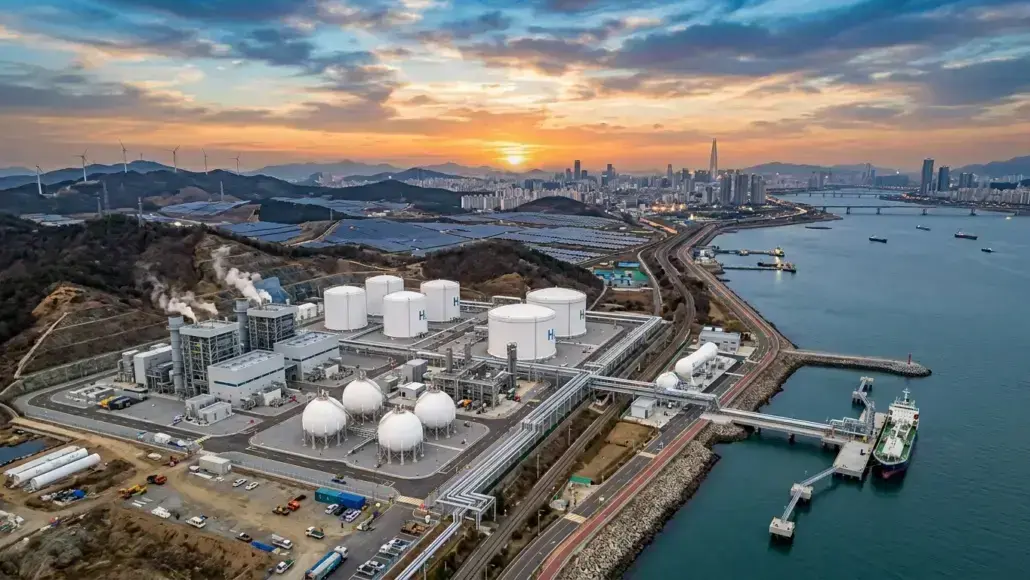
The effects and consequences of these initiatives are extensive. Economically, there is significant government funding, with a budget of 701.9 million for hydrogen projects in FY2021, as well as private sector commitments of more than 38 billion by 2030 from five large conglomerates. South Korea which is indeed seeking to be a global hydrogen powerhouse, wants to guarantee a steady supply of green hydrogen via foreign partnerships to increase its energy self-reliance from a geo-political viewpoint. The strategy is to develop the domestic production of clean hydrogen, such as blue hydrogen with carbon capture, and import terminals in terms of large-scale overseas supply.
Industry specific impacts include Hydrogen production to reach 5 million tonnes per year by 2040, with a heavy emphasis on clean hydrogen, reaching 93% of green hydrogen by 2050. This will require major developments in hydrogen infrastructure, such as storage facilities and pipelines, refilling stations, and will drive developments when it comes to fuel cell technology and hydrogen-powered transport, along with pursuing hydrogen as an alternative fuel as far as heavy industries are concerned.