













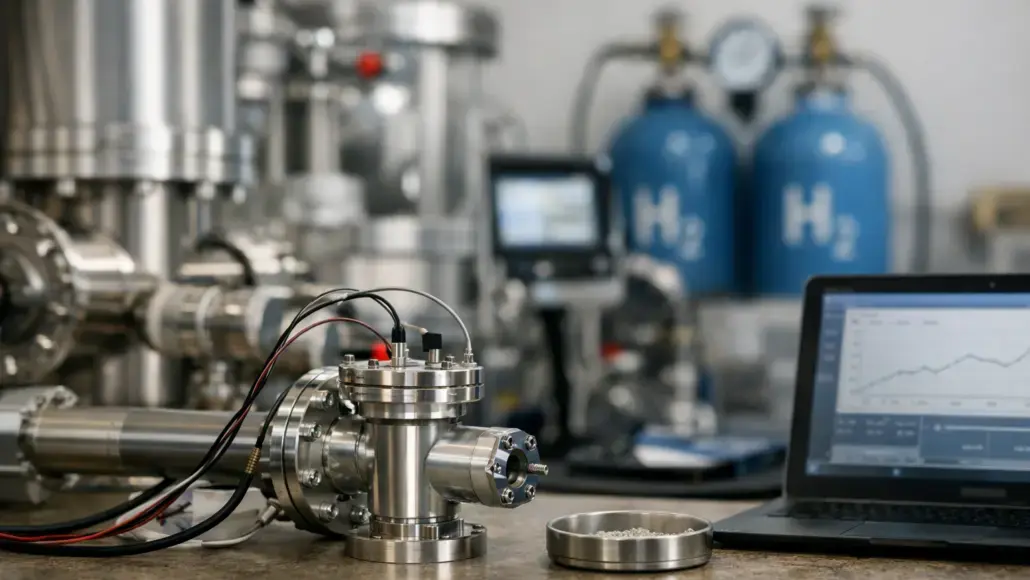

So far, measuring energy density of hydrogen has been nearly impossible, however a new sensor can detect each and every molecule. This could be a basis for an appropriate accounting standard in the hydrogen economy.
The fact is that people like to know how much they are shelling out for and what they are paying for, and so the way in which it is measured is key.
This forms the very basis of all trade and works well when the measurement mechanisms are in place, working and uniform.
But some substances wildly differ in their behavior, making it pretty challenging to quantify the amount – and to measure, account for, and trade.
Accurate gas measurement is key to green transition
The best illustration of a complicated measurement is hydrogen. What is the actual volumetric flow of gas past a given point in the pipe?
The problem was one for research, and Cignus Instruments turned to SINTEF in Norway, which has many years of experience when it comes to detailed flow calculations.
According to the chief scientist at SINTEF, Svend Tollak Munkejord, “Energy carriers like natural gas and hydrogen hold their value in each molecule. For hydrogen, the world’s lightest gas, it is difficult to measure the exact quantity, and so far this measurement problem has been an obstacle to the green shift.” He asks, “How can we know how much hydrogen is being sold or produced by an electrolyzer if we can’t be sure that the measurements are precise?”
It is well to be noted that hydrogen does not behave like other gases in pipes, either. It is so thin, so sensitive, and so rigid that minor variations in pressure and temperature make a big impact on measuring instruments that are already on the market. And if the gas of the smallest molecules is polluted with something bigger, the effect is huge, and the calculation of the amount of energy is overestimated.
Thick, stiff pipes do not work effectively with vibrating tubes
The tubes, which are made use of in the present times to measure mass flow, are coiled into a small, thin loop that vibrates. Minute changes in the vibration pattern are caused by the gas or liquid flowing through the loop. These measurements allow to determine the mass flow in the piping. These vibrating sensor tubes are known as Coriolis flow meters. Often several such Coriolis meters are needed in parallel, since they can only work with a precise diameter and wall thickness to retain their effectiveness.
The problem when determining the amount of hydrogen is that the high required pressure demands thick, rigid pipes, but at the same time the pipes must have adequate dimensions for the necessary delivery capacity. And, it is the complete opposite of the design and manufacture of Coriolis meters. This paradox is now solved by a new type of meter, which has no pressure or size constraints and is at the same time very sensitive for measuring hydrogen and all other light gases, like natural gas.
Says Martin Nese, CEO of Cignus Instruments, that “These gases will release their energy later, and then the number of molecules is what counts. The question we had to figure out is how many molecules flow through the tube, but without using the existing metre design.”
Like AutoPass when it comes to hydrogen molecules
The new design that leads to measuring energy density divides the tube into four channels. The junction may be inserted into any size and thickness of tube.
It’s like going from having to stop at the toll booth and pay manually to being able to just keep driving down the highway and get electronically registered without having to think about it.
The new meter operates on the exact same physical concept as Coriolis meters, says Nese. The technology can be seen as a fancy water meter with particular advantages for gas measurement in large-diameter pipes and at high operating pressures. But this metre is a measure of mass—the number of molecules—not volume.
“It’s kind of a hybrid speaker and mic. Nese says only that it is placed inside a tube.
Digital design of the gadget’s particulars
Eirik Holm Fyhn and Munkejord at SINTEF have been running simulations to find the best design of the meter to be mounted inside the pipe, prior to the time a physical product has been made. They are pleased with the result.
As per Fyhn, “What we are observing is that this metre can be used to precisely measure how much hydrogen passes through. We have also simulated what happens when the metre is inserted into a pipe near a bend, for example, a ninety-degree bend in the pipe. In short, we’ve shown that the metre works well even if there is a bend directly upstream of the meter.”
This means that pipe systems on the seabed no longer have to be laid after the meters have been laid out.
But the project is still in development. And the new meter must be measured and checked and certified itself prior to it can be the gold standard for meters.
Nese adds, “we are working on getting a hydrogen meter certified for the year.”
A new design of meter is important for measuring the amount of hydrogen coming out of an electrolyzer, both for checking the production process itself and for documenting the volume of hydrogen that is supplied.
The next phase is the adaptation of the meters for pipeline transport.
Germany has many hydrogen producers, so it is necessary to take measurements throughout all entry and exit points along with the pipeline network in order to make sure of precise control as well as settlement of accounts. Nese adds, “we believe this will make the hydrogen economy more efficient.”