

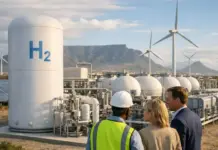

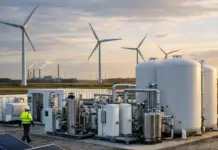
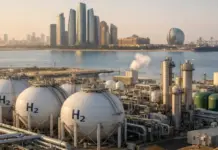






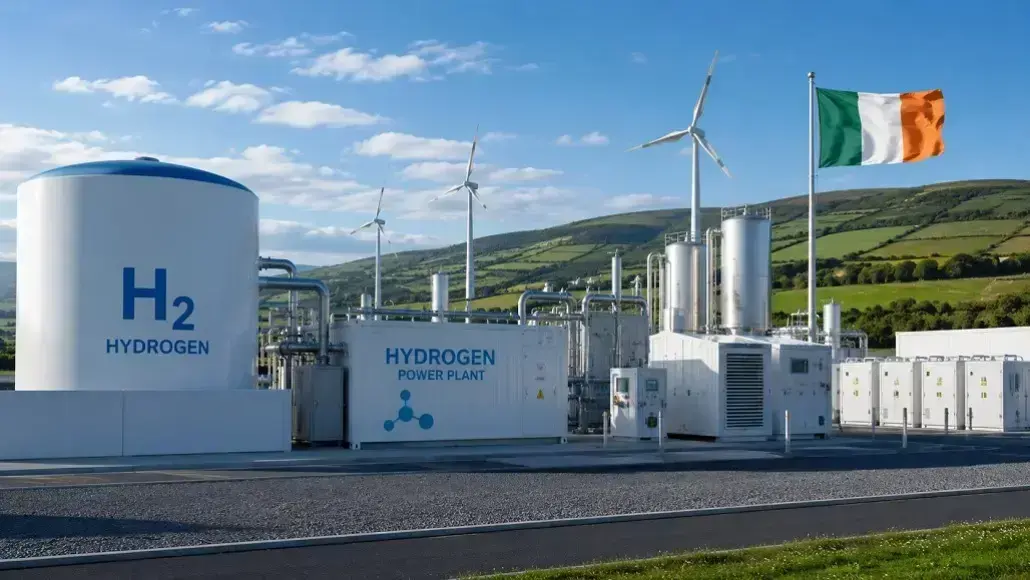

Ireland, because of its advantageous wind resource, strong government backing, and other positive attributes, could be a big player in hydrogen economy. This is the end of the HYreland project, which assessed the island’s capacity for green hydrogen and its synthesis products from a technological and economic as well as environmental perspective. For exports to Germany, the best alternative is by means of pipeline transport to the ports of Rotterdam or Stade, if available.
In the project, the Fraunhofer ISE scientists used a particularly developed and verified methodology to identify which areas on the island are optimal for renewable energies and large-scale power-to-X production. They assessed what innovative approaches offer potential for cost reduction in addition to how Ireland contrasts itself with other potential hydrogen producers. Liquid hydrogen, ammonia, methanol, dimethyl ether – DME and Fischer-Tropsch – FT products such as e-kerosene – SAF were studied. Besides local production costs, expenses associated with transport and shipment to Rotterdam, Duisburg and Stade by ship or pipeline were also determined.
Irish project partner ESB – Electricity Supply Board, which is Ireland’s leading energy company, had already pre-selected both locations of Aghada Generating Station on the south coast as well as Moneypoint Generating Station on the west coast. In an in-depth techno-economic study, the financial viability with respect to the PtX production potential was evaluated with the simulation toolbox – H2ProSim, designed at Fraunhofer ISE.
Favourable conditions in spite of a slight cost disadvantage
Ireland is on a par or barely better than other prospective export nations such as Morocco, South Africa and Brazil in the context of green hydrogen production costs, the study found.
According to Fraunhofer ISE’s project manager Christoph Hank, “There are a number of other aspects that speak in favor of Ireland as a location.”
For instance, the government encourages the utilisation of renewable energies for electricity production, as the functioning of data centers is projected to increase the electricity demand of the country by 30% by 2030. As an island nation, Ireland has to safeguard the fluctuating generation from renewable energy sources in its own country, and green hydrogen production serves as a versatile and responsive electricity consumer for this – the project modelled hydrogen production on an hourly schedule, taking into account changes in wind and solar generation. Other elements which underpin the production of hydrogen in Ireland are a competent workforce, existing experience in construction, operation and maintenance of large-scale generating plants, legal certainty and a favourable climate for investment and financing, particularly in the context of capital-intensive hydrogen projects.
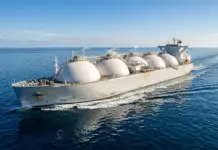
In addition to this, what pushes more about Ireland being a big player in hydrogen economy is its proximity to mainland Europe also makes it an attractive option for exporting green energy sources to Germany. The simulations from researchers suggest that the least expensive method of export would be to ship hydrogen by pipeline to Stade and Rotterdam. At this rate, including transport costs, the hydrogen delivered to Germany through this route would be priced between €160 and €205 per megawatt hour.
Preferred locations are indeed urban areas
HYreland carried out an analysis of the whole republic of Ireland, onshore as well as offshore, in terms of its appropriateness for renewable energy as well as PtX production. The appropriate places identified were the area around Cork in the south, the southeast of Waterford, the region around Moneypoint Generating Station on the west coast, the northeast of Wicklow, Dublin, and central/north Limerick, where the investigators used a GIS-based evaluation to identify the areas with established power grids and high wind power potential along with prospective local customers.
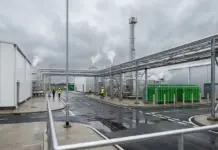
ESB, the Irish partner, is proposing the site of the Aghada Generating Station in County Cork, which is best suited to power-to-X projects. The site is attractive for the production of sustainable aviation fuels due to the nearby potential local customers such as Aghada power plant and Whitegate refinery as well as Cork Airport and alternatives to export either through a future pipeline or by ship from the Port of Cork.
Another possible source of bio-based CO2 is the nearby Midleton Distillery. In conjunction with the mentioned infrastructure connections and close proximity to the Whitegate Refinery, it is a highly appropriate base for an industrial SAF project. It is important, for all locations, that there are local consumers for hydrogen and its derivatives.
Explains Lucas Edenhofer, GIS analyses expert at Fraunhofer ISE, that “these can be refineries and power plants.”
HYreland Project Acknowledgements
The project was awarded the German-Irish Business Award on November 7, 2025. This is the first award which recognises businesses that have especially dedicated themselves to social responsibility along with the promotion of economic relations between Germany and Ireland.
According to Keelan Glennane from Irish project partner ESB, “Winning this award in such a broad and competitive field is a testament to the exceptional work we have done together. This achievement is not only an accolade for HYreland but also reflects the commitment, expertise, and team spirit of each and every member of our team.”
The HYreland project has also been recognised by the UN Decade of Ocean Science for Sustainable Development due to its impact.
“International Green Hydrogen Supply Chains: From Vision to Cost Reality – The HYreland Project as a Practical Example” – by Friedrich Mendler – will go on to present the project outcomes in detail on May 20 at 4 p.m. at the World Hydrogen Summit to be held in Rotterdam.