







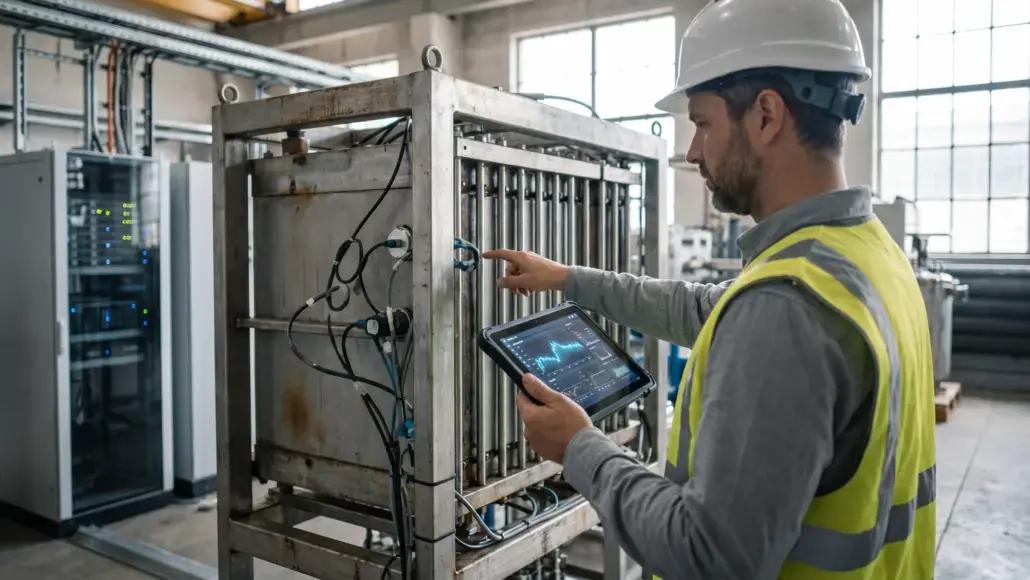

The transition toward a global hydrogen economy is fundamentally dependent on the scalability and efficiency of green hydrogen production. At the heart of this transition lies the electrolyzer, a sophisticated electrochemical device that splits water into hydrogen and oxygen using renewable electricity. However, the operational complexity of large-scale electrolyzer stacks presents significant hurdles, ranging from energy intensity to rapid component degradation. In recent years, the deployment of artificial intelligence (AI) has emerged as a cornerstone in overcoming these barriers. AI Optimizing Electrolyzer Performance is no longer a futuristic concept but a present-day industrial imperative that ensures the economic viability of zero-emission fuels.
As hydrogen plants scale up to megawatt and gigawatt capacities, the sheer volume of data generated by sensors monitoring pressure, temperature, current density, and gas purity becomes overwhelming for traditional control systems. Machine learning models, particularly those based on deep learning and reinforcement learning, are uniquely suited to ingest these vast datasets. By identifying subtle patterns that precede efficiency drops or mechanical failures, these AI systems allow for a level of granular control that was previously unattainable. This transition from reactive management to proactive, data-driven optimization is redefining the performance benchmarks for both Proton Exchange Membrane (PEM) and Alkaline Water Electrolyzer (AWE) technologies.
The Role of Predictive Modeling in Enhancing Electrochemical Efficiency
Enhancing the efficiency of an electrolyzer requires a deep understanding of the internal electrochemical dynamics that occur at the micro-scale. One of the primary challenges in hydrogen production is the overpotential the extra energy required beyond the thermodynamic minimum to drive the electrolysis reaction. AI-driven predictive modeling enables engineers to analyze the relationship between varying input parameters and the resulting overpotential in real-time. By utilizing neural networks trained on historical performance data, AI can predict the optimal operating point for a stack under any given set of environmental conditions.
Furthermore, AI Optimizing Electrolyzer Performance involves the stabilization of the current-voltage (I-V) curve. In renewable-powered plants, the input energy is inherently intermittent. Sudden spikes or drops in wind and solar power can lead to thermal stress and fluctuating gas production rates. Advanced AI algorithms can modulate the power supply to the electrolyzer in a way that maximizes gas output while keeping the system within its most efficient thermal window. This dynamic load balancing not only improves the overall energy conversion efficiency but also protects the expensive catalysts and membranes from the detrimental effects of rapid cycling.
Mitigating Degradation through Intelligent Condition Monitoring
The longevity of electrolyzer components is a critical factor in the Levelized Cost of Hydrogen (LCOH). Membranes and electrodes are subject to various degradation mechanisms, such as chemical crossover, catalyst leaching, and mechanical wear. Traditional maintenance schedules are often based on fixed time intervals, which can lead to either premature replacement of healthy components or catastrophic failures between inspections. AI changes this paradigm through intelligent condition monitoring and the development of Virtual Health Indicators (VHIs).
By applying anomaly detection algorithms to the sensor data, AI can distinguish between normal operational fluctuations and the early signs of material fatigue. For instance, a slight increase in cell resistance that might be ignored by a human operator can be flagged by an AI model as an indicator of membrane thinning. This early detection allows for targeted maintenance, ensuring that the system only undergoes downtime when absolutely necessary. Consequently, AI Optimizing Electrolyzer Performance directly translates to extended asset life and reduced capital expenditure over the plant’s lifecycle.
Integrating Physics-Informed Neural Networks for Deeper Insights
While data-driven models are powerful, they sometimes lack the ability to generalize beyond the specific datasets they were trained on. To address this, industry leaders are increasingly adopting Physics-Informed Neural Networks (PINNs). These hybrid models combine the flexibility of machine learning with the fundamental laws of thermodynamics and fluid dynamics. By embedding physical constraints into the AI’s learning process, the system can provide more accurate predictions even in scenarios it has not encountered before, such as extreme weather events or unusual gas purity levels.
This hybrid approach is particularly effective in modeling bubble dynamics within the electrolyzer cells. The accumulation of hydrogen and oxygen bubbles on the electrode surfaces can significantly increase electrical resistance and reduce active surface area. AI models capable of simulating and predicting bubble behavior allow for the optimization of electrolyte flow rates and electrode geometry. Through these micro-level adjustments, the AI ensures that the electrochemical active surface area is maximized, further driving the narrative of AI Optimizing Electrolyzer Performance to its physical limits.
AI-Driven Electrolyte Management and Chemical Purity Control
Beyond the hardware of the stack itself, the chemistry of the electrolysis process requires meticulous management. In alkaline systems, the concentration of the potassium hydroxide electrolyte must be kept within tight tolerances to maintain conductivity and prevent corrosion. AI systems can continuously monitor electrolyte composition and automate the dosing of deionized water or concentrated solution. By predicting how concentration will drift based on temperature and production rates, the AI maintains a chemical equilibrium that optimizes ion transport and minimizes energy losses.
Furthermore, gas purity is a paramount concern for downstream applications like fuel cells or industrial synthesis. Even trace amounts of oxygen in the hydrogen stream or hydrogen in the oxygen stream can create safety hazards and reduce product value. AI algorithms analyze gas chromatography data in real-time to detect the onset of gas crossover a common symptom of membrane degradation. By correlating these purity levels with operational stressors, the AI can adjust the pressure differentials across the membrane to mitigate crossover, ensuring that the plant consistently delivers high-purity hydrogen while AI Optimizing Electrolyzer Performance stays at the forefront of safety protocols.
Multi-Stack Coordination and Scalability in Large-Scale Plants
As the industry moves toward gigawatt-scale facilities, the challenge shifts from optimizing a single electrolyzer to coordinating dozens or even hundreds of stacks. This is where AI truly shines in its ability to handle complex system-of-systems architectures. In a large plant, not all stacks are identical; subtle manufacturing variations and differing ages mean that each stack has a unique efficiency profile. An AI-based plant controller can intelligently distribute the load across the fleet, assigning more current to the most efficient stacks and giving aging units a lighter load to preserve their remaining life.
This multi-stack coordination also extends to thermal management. The heat generated by one stack can be recovered and used to preheat the feed water for another, provided the system is managed with precision. AI models simulate the thermal gradients across the entire facility, optimizing the operation of heat exchangers and cooling towers. By treating the entire plant as a single, integrated thermodynamic system, AI Optimizing Electrolyzer Performance ensures that thermal energy is not wasted, thereby improving the round-trip efficiency of the hydrogen production process.
Data Infrastructure and the Role of Edge Computing
To realize these AI-driven benefits, a robust data infrastructure is essential. Hydrogen plants are often located in remote areas with limited connectivity, making cloud-based AI processing challenging for real-time applications. The solution lies in edge computing deploying AI models directly on local industrial controllers. This allows for sub-second response times, which is critical for protecting electrolyzers from sudden power surges or pressure spikes.
The AI models at the edge work in tandem with centralized cloud systems that perform more computationally intensive tasks like long-term degradation modeling and fleet-wide benchmarking. This tiered architecture ensures that the plant remains responsive to immediate threats while benefiting from the collective intelligence of the entire industry. As more data is gathered, these models become increasingly refined, leading to a virtuous cycle of improvement where AI Optimizing Electrolyzer Performance becomes more effective with every hour of operation.
Economic Impact and the Path to Parity with Fossil Fuels
The integration of AI is not merely a technical exercise; it is a fundamental driver of the hydrogen economy’s economic viability. By improving efficiency by just a few percentage points, AI can shave millions of dollars off the annual operating costs of a large-scale plant. When combined with the extended stack life achieved through predictive maintenance, the impact on the Levelized Cost of Hydrogen is profound. Industry analysts suggest that AI-driven optimization could be the single most important factor in bringing green hydrogen down to the $2 per kilogram target, making it competitive with “grey” hydrogen produced from natural gas.
Moreover, the transparency provided by AI monitoring makes hydrogen projects more attractive to investors. Detailed records of stack health and performance, backed by AI analytics, reduce the perceived risk of the technology. This facilitates lower interest rates for financing and accelerates the deployment of new projects. In this way, AI Optimizing Electrolyzer Performance serves as both a technical catalyst and a financial enabler, paving the way for a decarbonized industrial future.
The Future of Smart Hydrogen Infrastructure
Looking ahead, the role of AI will only expand as we move toward the concept of “smart” hydrogen plants. These facilities will not only optimize their own performance but will also communicate with the broader energy grid. AI will enable hydrogen plants to act as flexible loads, absorbing excess renewable energy during periods of high production and scaling back when the grid is stressed. In this context, AI Optimizing Electrolyzer Performance becomes a tool for grid stability, providing a dual benefit of clean fuel production and energy system resilience.
The continuous evolution of AI algorithms, coupled with the increasing availability of high-fidelity industrial data, promises a future where hydrogen production is fully autonomous. We are moving toward a reality where the AI system itself initiates maintenance requests, orders replacement parts, and recalibrates the entire plant for maximum efficiency without human intervention. This level of autonomy will be the defining characteristic of the next generation of hydrogen infrastructure, ensuring that the world has a reliable and affordable supply of clean energy for decades to come.