













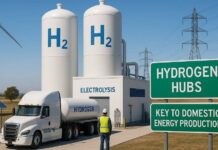



Estonia’s government has launched a state special planning process to map out an onshore hydrogen pipeline path across its territory, seeking to ensure profitable transit fees and boost homegrown green energy projects.
But the land project faces intense rivalry from a parallel maritime project that follows the path of the abandoned Nord Stream natural gas pipelines.
The consortium of European energy companies strategises to construct a rival pipeline, situated directly on the Baltic seabed, connecting Finland and Germany.
In April 2026, GASCADE, the German pipeline operator importer SEFE Securing Energy for Europe and the Baltic Sea Hydrogen Collector consortium made up of Finnish as well as Swedish developers went on to formally agree to work together on the undersea route.
Both projects aim to supply green hydrogen to German industrial facilities that want to be CO2 neutral by phasing out natural gas. Green hydrogen is generated from renewable energy.
The head of Estonian electricity and gas system operator Elering, Kalle Kilk, said it was not feasible to build both pipelines at the same time. The choice was up to Finland and Germany as they evaluated their options, he said.
Although an undersea route would bypass disputes over land ownership as well as negotiations with local governments, Elering, along with Estonian officials, is strongly in favour of the on-land route. The hydrogen pipeline passing overland is important for the viability of planned hydrogen manufacturing plants in the Pärnu region of Estonia, which would have difficulties connecting to a maritime line.
Officials in Tallinn also hope for a physical land pipeline, as it will encourage Germany to play a larger role in the regional security of Estonia.
According to Kalle Kilk, Pärnu is obviously quite far from the sea route. It would certainly be easier for Pärnu projects to connect to a hydrogen pipeline passing overland.
Apparently, the Estonian government hopes to identify particular alternative corridors south from northern Estonia to Latvia by the start of 2027.
Companies are not anticipated to make their final investment choices until 2030 or 2031, given the long-term regional nature of the infrastructure.