
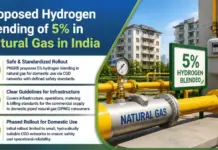







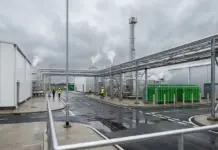










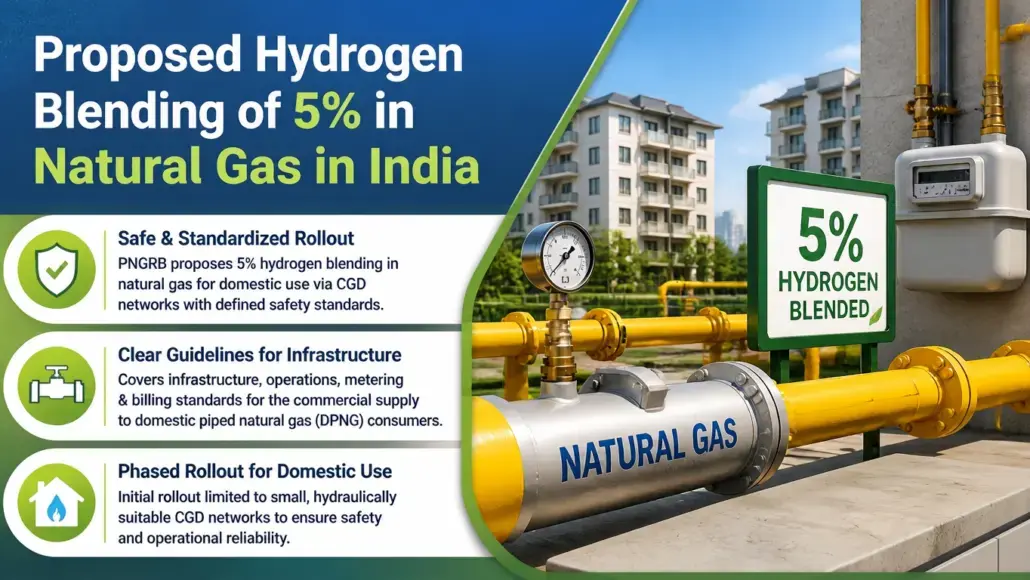

India’s Petroleum and Natural Gas Regulatory Board – PNGRB has suggested a proposed hydrogen blending of 5% in natural gas by volume that is supplied to domestic consumers by means of city gas distribution – CGD networks. The proposed guidelines lay down safety standards, infrastructure, operational, and metering as well as billing standards when it comes to commercial supply to domestic piped natural gas – DPNG consumers.
The structure confines the initial rollout to small, hydraulically defined zones targeting domestic consumers, with a single injection point. Commercial supply would not start till the distributors have explicit approval from PNGRB, statutory permits, and proof that their networks can safely accommodate the suggested hydrogen concentration.
Strict controls are required for hydrogen injection
The proposed hydrogen blending of 5% is not a normal operating target. Distributors would have to maintain a smaller typical operating setpoint, with a verified margin to avoid hydrogen levels above the allowed limit during peak or minimum demand, start-up, shutdown, or even operational disturbances.
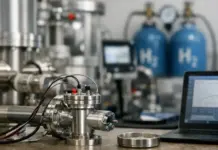
The guidelines also specify regular monitoring of the hydrogen concentration, validated mixing and control systems, and protective arrangements to stop the hydrogen injection if critical measurements are lost or operating conditions deviate from approved limits. The structure does not include compressed natural gas – CNG, hydrogen-enriched compressed natural gas – HCNG, automotive applications, gearbox pipelines and pure hydrogen supply, refueling, de-blending and non-domestic piped natural gas consumers except when separately approved by PNGRB.
Review of Existing Networks
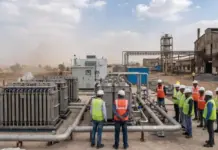
Gas distributors would have to inspect the pipelines, joints, valves, meters, pressure regulators, and seals, as well as household appliances, before they can introduce hydrogen. The evaluation must take into account the specific network, equipment, and operating conditions and not presume evidence from another project proves universal compatibility.
It is well to be noted that the proposed requirements are applicable to the hydrogen acceptance and interface point, the blending facility, and the downstream domestic network. Upstream of this point, hydrogen production, transportation, compression, and storage are outside the scope of this document and are subject to applicable laws and regulatory approvals.
Engineers India – EIL and IIT Kanpur have studied the effect of green hydrogen mixing in city gas distribution pipelines and submitted the report to the Ministry of Petroleum and Natural Gas – MoPNG. EIL’s study recommended hydrogen blending in the range of 3-5%.
Transmission Pipelines in the Spotlight
In March 2024, PNGRB said it was exploring the deployment of natural gas transmission pipelines to carry green hydrogen through blending. The regulator had looked into the possibility of using existing gearbox infrastructure to move hydrogen from where it was produced to where it was needed. Hydrogen can help integrate renewable energy and can be used in the transport and industrial sectors. In existing gas networks its use demands evaluations of pipeline reliability, gas quality, metering, and appliance compatibility, as well as consumer billing.
India’s yearly demand for hydrogen is around 6 million tonnes, roughly 6% of the global demand. The stakeholders have time to submit their comments on the proposed guidelines till 12 November 2026. The commercial deployment would still be contingent on regulatory approval and proof that each participating network fulfills the mandated safety and operational requirements.