





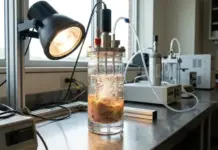









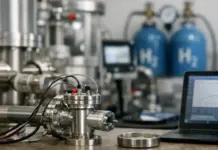












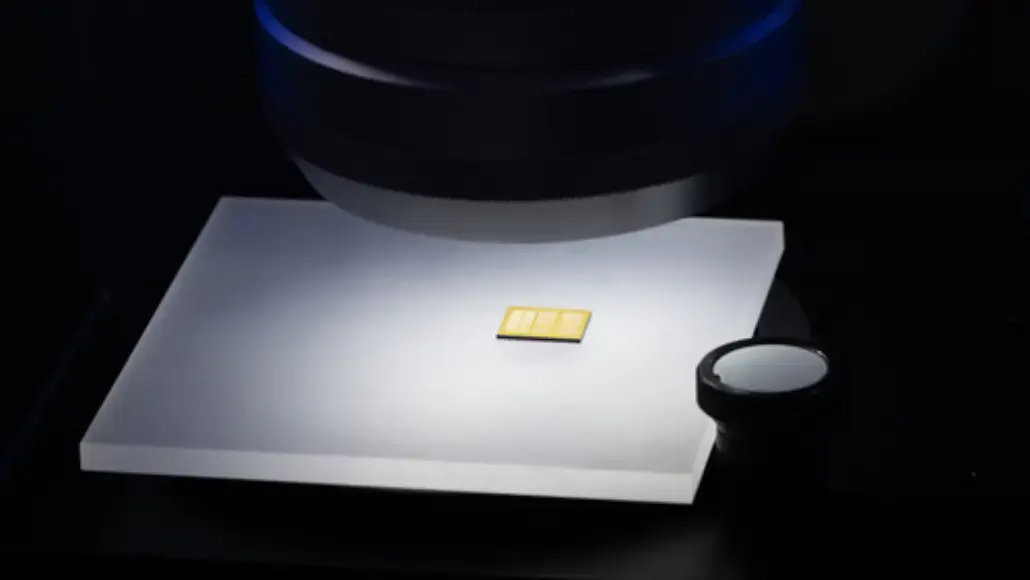

Scientists have created an organic photoelectrode splitting water into green hydrogen by using just sunlight, with no external power needed. The device achieved a solar-to-hydrogen conversion efficiency of 7.9%, which, by the way, is the highest reported for a non-biased organic semiconductor photocathode, and also showed a possibility of large-area outdoor operation and reduced manufacturing expenses.
A research team headed by the Graduate School of Carbon Neutrality’s Professor Kim Jin-young, as well as Professors Lee Jae-sung and Lim Han-kwon of the Department of Energy and Chemical Engineering at the Ulsan National Institute of Science and Technology – UNIST has developed a tandem photoelectrode that stacks two layers of light-absorbing organic semiconductors, the university said on October 26, 2026. The findings appeared online on September 6, 2026 in Applied Catalysis B: Environment and Energy, an international journal in the environmental and energy catalysis field.
It is well to be noted that splitting water into green hydrogen is an environmentally benign technology to generate it without carbon dioxide emissions. Low-temperature processes for the fabrication of organic semiconductor-based photoelectrodes, in which the material is dissolved in a solution and coated on a surface, are advantageous when it comes to large-area fabrication and cost reduction. But it’s not easy to create the voltage required to split water – 1.23 volts or more – using just a single absorbing layer, so an external power source was necessary.
They tried to stack two semiconductor layers to increase the voltage, but the traditional interconnecting material, PEDOT:PSS, is very acidic and sensitive to moisture, which can corrode the neighboring layers.
So as to take care of the problem, the team inserted a new hybrid interconnecting layer between both the organic semiconductor layers that absorb light at distinct wavelengths – a combination of molybdenum oxide – MoOx and an organic molecule called 2PACz. Molybdenum oxide is not acidic, holds little moisture, and prevents a typical penetration of solvents utilized when coating the upper semiconductor. The 2PACz molecule decreases the flaws in the oxide and boosts the bond between thin films, allowing the charges to move without loss.
For performance testing, the team achieved a high onset voltage of 1.67 volts. The photoelectrode, with an area of 0.56 square centimeters, demonstrated an efficiency of solar energy to hydrogen conversion of 7.9% without any external power source, which is the highest efficiency in the world for organic semiconductor photocathodes operating without an imposed bias. The device also exhibited superior durability, keeping 86% of its starting photocurrent after 10 hours of uninterrupted operation. On the other hand, the photocurrent of a photocathode with the typical interconnecting material declined considerably to about 36%. The team also developed a large-area module system of 320 square centimeters and demonstrated the module’s ability to generate hydrogen outdoors in natural sunlight without an external voltage.
The researchers additionally decreased the dependence of the device on valuable metals and its processing costs. The amount of platinum in the hydrogen-evolving photoelectrode was reduced to around 0.1% by weight, and the oxygen-evolving electrode employed a nickel-iron-cobalt – NiFeCo catalyst rather than highly precious metals. Both electrodes are in the same potassium hydroxide solution, so no additional ion-exchange membrane is needed.
A techno-economic assessment – TEA of the entire process calculated the cost of generating hydrogen at $9.26/kg for a production rate of 10 tons/day and a current efficiency of 7.9%. The system achieved similar economics to inorganic photoelectrodes having conversion efficiencies of 10%, owing to lower electrode fabrication costs based on organic semiconductors. The analysis showed that if the conversion efficiency was pushed to the theoretical level of 16% and the daily output was increased to 30 tonnes, the production cost could be reduced to $4.26 per kilogram. The turbulence and corrosion-related issues of the interconnecting layer, which had been a chronic limitation for layered organic semiconductor electrodes, have been dealt with, said Kim. This will help reduce the cost of making green hydrogen using organic semiconductors that can be processed in solution.
The co-first authors were researchers Kim Jae-hyung and Lee Yeon-jeong, as well as Moon Jong-a, along with Dr. Dharmesh Hansora. This research was facilitated by the National Research Foundation of Korea – NRF grant funded by the Ministry of Science and ICT and also by UNIST.