








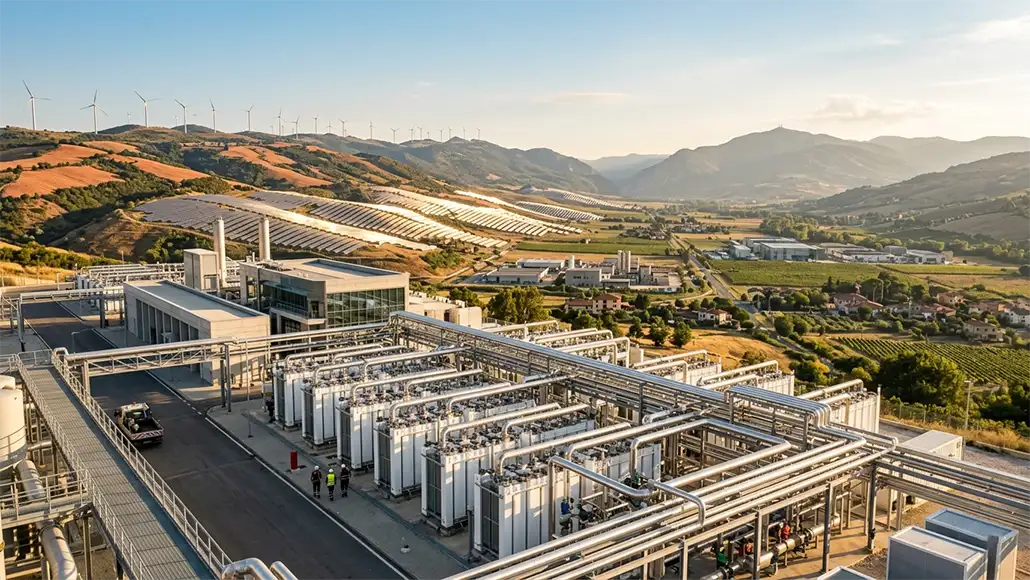

The European Commission has approved a €6 billion Italian scheme to support renewable hydrogen production for the transport and industrial sectors under EU State aid rules. The scheme is going to contribute to the growth of renewable hydrogen production capacity in accordance with the goals of the EU Hydrogen Strategy as well as the Clean Industrial Deal.
The Italian scheme
Italy notified the Commission of a scheme to support renewable hydrogen production that totals 200 000 tonnes of renewable hydrogen per year. The measure includes hydrogen produced from biogenic sources through biological, bio-thermochemical and thermochemical processes as well as hydrogen produced through electrolysis powered by electricity from renewable energy sources.
The aid will come as two-way contracts for differences. Under these contracts, the hydrogen strike price will be determined by a competitive bidding process. And if the price of an alternative fuel that hydrogen consumers would use dips below that strike price, Italy will reimburse hydrogen producers the difference. If the price of the hypothetical fuel is higher than the strike price, the recipients will pay the variance to the Italian state.
The scheme will be in place until 31 December 2029.
The evaluation of the Commission
The Court of Justice examined the scheme under the EU State aid rules, and in particular Article 107(3)(c) of the Treaty on the Functioning of the European Union – TFEU, which allows Member States to support the development of certain economic activities under certain conditions, and the 2022 Guidelines on State aid for climate, environmental protection, and energy – CEEAG.
The Commission in particular found that –
- The aid is required and suitable to support the production of renewable hydrogen to decarbonize the transport and industrial sectors.
- The aid has an incentive effect, as the beneficiaries wouldn’t generate renewable hydrogen without public support.
- The aid will be awarded after a competitive bidding process based solely on the strike price offered by bidders and will be proportional.
- The aid will have positive effects, particularly for the environment, as it will help decarbonise sectors with high emissions. The positive effects surpass the negative effects on competitiveness.
The Commission approved the Italian scheme on this basis under EU State aid rules.
Background
The 2022 CEEAG provides guidance on the Commission’s assessment of the compatibility of environmental protection, including climate protection and energy aid measures, which are subject to the notification requirement under Article 107(3)(c) TFEU. The Guidelines offer a flexible and enabling framework fit for purpose to assist Member States so as to provide the necessary support to achieve the Green Deal goals in a targeted and cost-effective way.
In July 2020, the Commission published its EU Hydrogen Strategy with ambitious targets for the production and deployment of clean hydrogen and launched the European Clean Hydrogen Alliance, getting together the European hydrogen community – industry, civil society, and public authorities.