

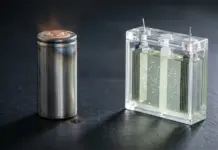

























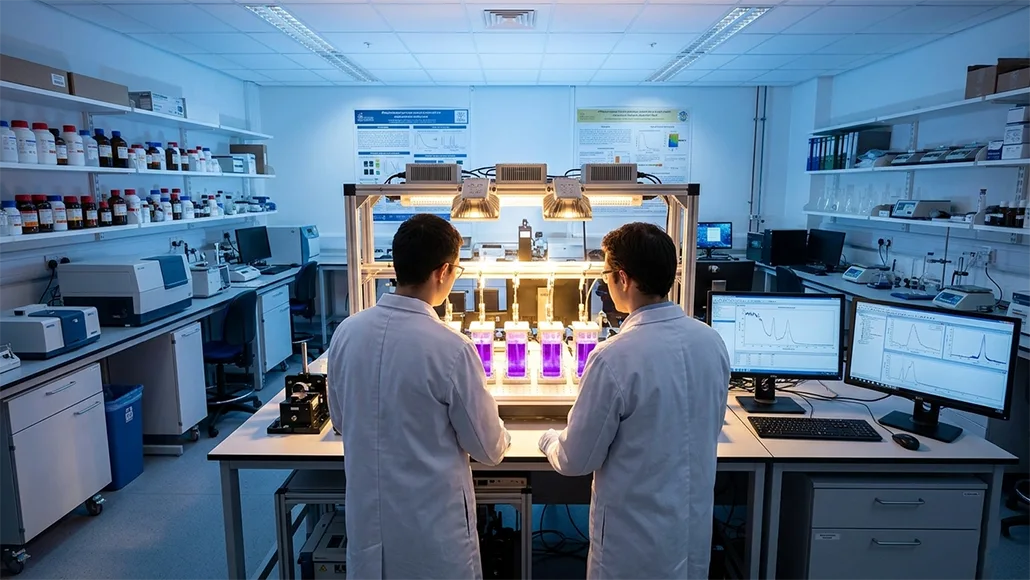

In a recent development, a new copolymer-based battery, which has been developed by Ulm and Jena universities’ researchers in Germany, goes on to store energy coming from sunlight for days and can even release it when needed as green hydrogen.
The copolymer-based battery happens to be rechargeable, with both the charge as well as the discharge process getting activated through flipping a pH switch, said a press release.
With the idea of switching away from fossil fuels, there are countries across the world that are now going ahead and adopting large-scale solar and wind power plants. But when it comes to applications that need higher energy density, hydrogen happens to be a more viable alternative. It can get burnt, like a fossil fuel, however it produces just water as a byproduct, thereby offering a carbon-free solution in terms of energy-intensive applications.
But the fact is that hydrogen production alone can prove to be a carbon-emitting process. Large-scale hydrogen plants make use of methane reforming in order to produce hydrogen, as it is a cost-effective option. As far as hydrogen being an ideal replacement when it comes to fossil fuels, it had to be produced by way of using solar or wind energy, which is also called green hydrogen.
Copolymer comes to the rescue
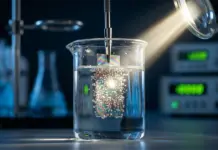
It is well to be noted that green hydrogen can be produced through sunlight by way of a photocatalytic process. As the gas gets produced, it requires getting stored separately within tanks and getting processed as and when required. But a research team, which is led by Jena University’s Ulrich Schubert and Ulm University’s Sven Rau, went on to decide to rather make use of copolymer molecules.
Apparently, copolymers happen to be macromolecules that have in it varied organic building blocks. They consist of a balanced framework and can get equipped with certain specific functional units. For this solar battery, researchers make use of a water-soluble copolymer having reinforced redox activity as its major functional unit.
When getting exposed to sunlight, the system attains a charging efficiency of 80%, and once charged, the system can go on to maintain the charged state for many days. In order to retrieve the energy, researchers went on to add an acid along with a hydrogen-evolution catalyst so as to cause the electrons, which are stored in the system, to mix with protons, hence causing a hydrogen release. In this scenario, the efficiency of the system is high again, as it touches 72%.
pH as a switch getting used
Notably, the copolymer-based system has in it redox reactions, which are entirely reversible. Hence, when a battery gets discharged, it can be left in the sun in order to recharge, hence enabling numerous catalytic as well as storage cycles.
In order to reset the system, researchers simply make alterations in the pH value. However, pH isn’t just a switch but also an indicator of the state of the charge of the polymer. At the time of discharge, the presence of acid makes color alterations from violet to yellow.
When the case is placed in the sunlight to charge, the system alters the color again from yellow to violet, thereby showcasing that the battery is charged and can release as hydrogen when required. Notably, the hydrogen released could be made use of for a wide array of applications, right from running the electric cars to going ahead and manufacturing steel or even generating clean electricity whenever it is needed.
The fact is that the project is also of scientific relevance since it blends varied concepts from chemistry that are otherwise pretty less in contact, like macromolecular polymer chemistry as well as photocatalysis, said Rau in the press statement.
Schubert went on to conclude that “The results open up new perspectives for cost-effective, scalable solar storage technologies – and provide an important building block on the way to a sustainable, chemical-based energy economy.”
The research findings have been published in Nature Communications.