




























A team of University of Michigan researchers has gone on to develop quantum materials that could as well revolutionize the production of hydrogen fuel through using just sunlight and water.
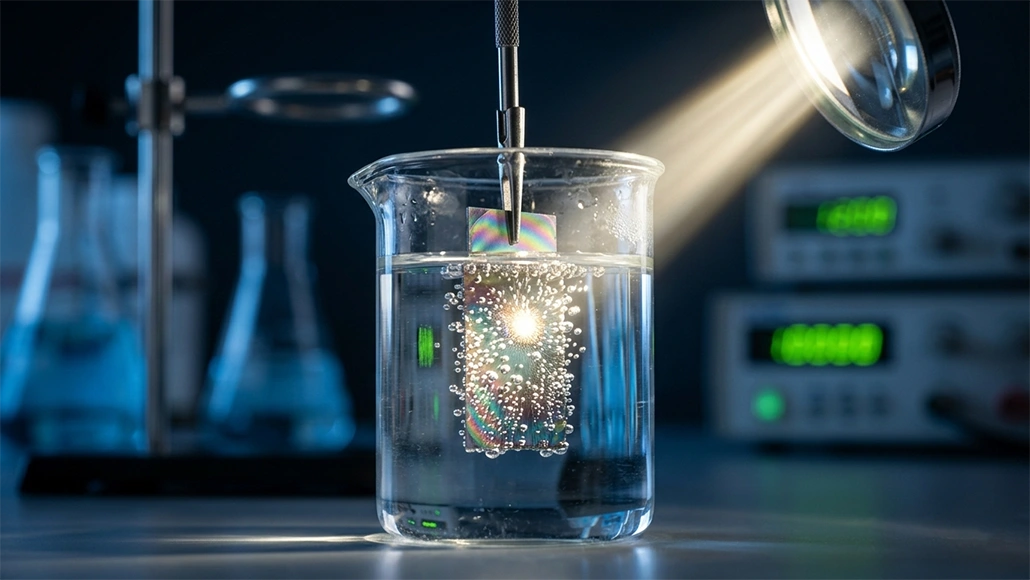
In one of the significant breakthroughs, the team has addressed issues in photocatalytic water splitting, which apparently is a method so as to produce clean hydrogen. When it comes to tests, their excitonic quantum superlattices showcased an appealing efficiency in terms of clean hydrogen production.
What are excitonic quantum superlattices?
Hydrogen fuel goes on to hold quite a major promise when it comes to decreasing the greenhouse gas emissions, since it goes on to emit just water vapor at the time of burning. It could as well one day even power heavy-duty vehicles such as the likes of trucks, trains, and even ships for that matter and also prove to be a major support in terms of industrial heating and decentralized electricity systems. But traditional production of hydrogen fuel in most cases depends on fossil fuels, thereby not giving enough attention to its environmental benefits.
It is well to be noted that the photocatalytic water splitting approach makes use of sunlight in order to drive a chemical reaction. This indeed has the potential to help generate large-scale and eco-friendly hydrogen.
Notably, the University of Michigan team did address the longstanding challenge related to inefficient photocatalysts in a scenario of splitting water molecules into hydrogen as well as oxygen, hence offering a much cleaner alternative to methods that are fossil fuel-dependent.
They created excitonic quantum superlattices, which are made out of ultra-thin layers of gallium nitride as well as indium gallium nitride. These go on to form a periodic stack, which elevates the optoelectronic traits. At the end of the day, the team could find that these materials were able to split water and also produce clean energy with great efficiency.
A step toward clean hydrogen production
The tests by the team gave out impressive results. Their materials showcased a solar-to-hydrogen efficiency of 3.16% due to ambient conditions having concentrated sunlight and also an average of 1.64% in outdoor scale-up demonstrations, which were under 204-fold sunlight intensity.
The researchers confirmed in a paper that producing clean hydrogen, and that too directly from the sunlight as well as water, has popped up as a much more promising path in order to achieve neutrality in carbon along with environmental sustainability.
They continued that, however, the inefficient utilization when it comes to photogenerated charge carriers within photocatalysts does affect the solar-to-hydrogen efficiency and that the researchers show the usage of excitonic quantum superlattice structures, which consist of nanometer-scale gallium nitride along with indium gallium nitride, in order to attain effective charge steering related to photocatalytic overall water splitting.
The researchers made use of the quantum-confined Stark effect in order to extend the lifetime of photogenerated indirect excitons, which are pairs of electrons as well as holes that are bound by Coulomb interaction.
While such kinds of efficiencies demonstrated during the testing are a step forward, they still remain below the levels that are needed in order to experience a widespread commercial adoption. The work still showcases the potential of quantum superlattices when it comes to photocatalytic systems. Future elevations could also enhance performance, thereby inspiring similar designs that relate to other materials.
The fact is that the new breakthrough could also enable us to avert the worst effects pertaining to climate change via aiding in the shift towards renewable fuels. As demands for energy grow, this work could as well play an important role when it comes to attaining carbon neutrality, decreasing the dependence on fossil fuels, and eyeing a greener planet.