






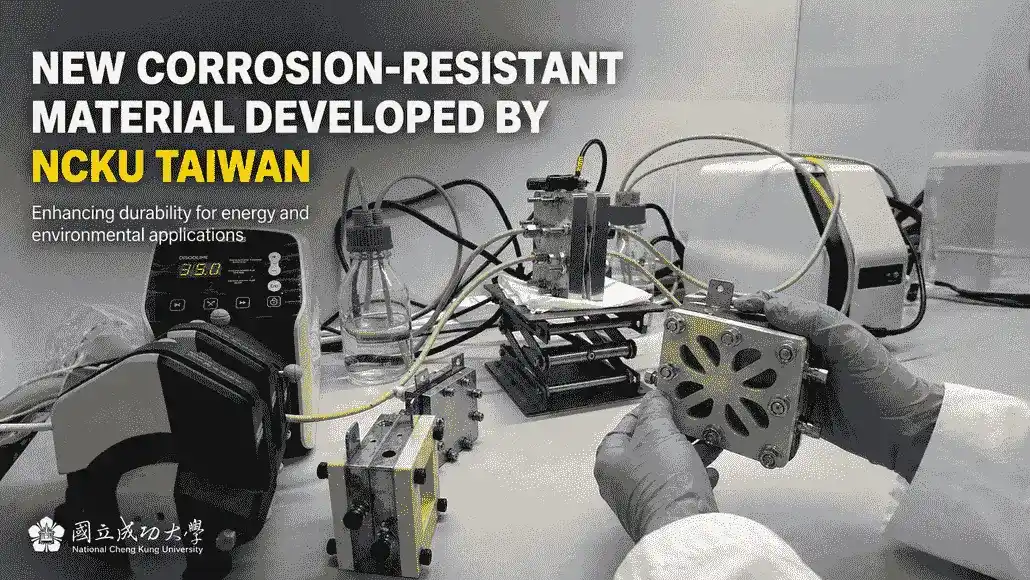

A team from Tainan’s National Cheng Kung University – NCKU has gone ahead and developed a new corrosion-resistant material in order to improve hydrogen production by seawater electrolysis, significantly overcoming major obstacles in the process, reported UDN.
It is worth noting that hydrogen is a clean energy source and also a major industrial raw material which goes on to help reduce carbon emissions, NCKU said. Electrolysis of seawater may provide new sources of hydrogen supply, however, the salt and chloride ions in seawater can seriously corrode electrodes, which is indeed a major technical challenge.
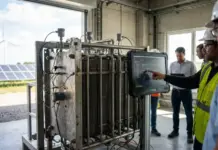
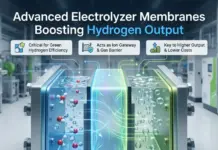
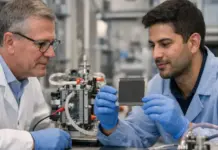
In order to solve this, the team tested under seawater conditions with a water electrolysis system as well as a special membrane, said NCKU’s Materials Science and Engineering Department professor Ting Jyh-ming. It is well to be noted that the technology has been published in the international journal Advanced Functional Materials and happens to be in development with the industry collaborators.
Apparently, the new corrosion-resistant material which has been developed with the support from the National Science and Technology Council, can run over 2,000 hours at high current density, enabling stable hydrogen production. The team has also gone ahead and developed a multi-cell stack which is capable of generating hydrogen even at low current density. This technology is protected by patent.
Ting said that the solar-powered freshwater electrolysis is considered more environmentally friendly compared to producing hydrogen from natural gas. But he stated the process is expensive, requires vast amounts of high-purity fresh water and poses challenges such as explosion risks and storage problems.
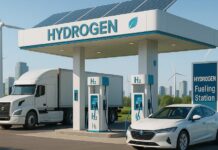
According to Ting, the technology will likely encourage broader use of hydrogen, such as in hydrogen-powered vehicles and fuel cells. To further promote hydrogen adoption, CPC and Linde LienHwa Industrial Gases opened the first hydrogen refuelling station in Taiwan in December 2025 at Kaohsiung.
The government has already identified hydrogen energy as an essential approach for attaining net-zero emissions by 2050. By that year it seeks to generate 40% of its hydrogen locally and import the remainder.
Notably, National Central University has been working with Julich Research Centre of Germany since November 2025 to set up a hydrogen energy research centre. The facility would prioritise hydrogen production through hydrogen fuel cell materials and water electrolysis along with smart grid technologies.