


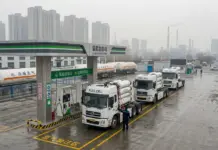



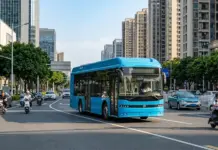



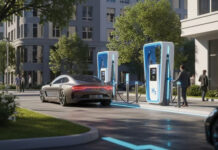
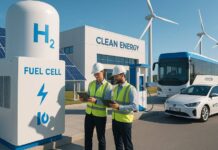


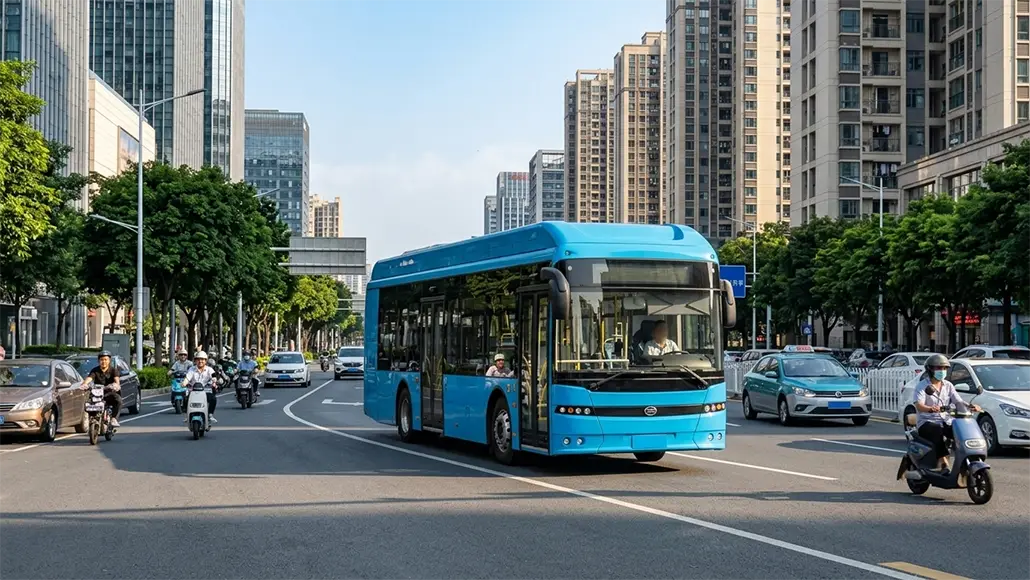

The Nanhai district is the capital of China’s hydrogen energy industry, and bright blue public buses powered by hydrogen fly along the streets there. The words written on their sides say, The future is here.
Nanhai, in Foshan, a city in the south, is a supporter of hydrogen, which has long been thought of as a clean fuel for the future. But in China, as in other places, its wider use has been limited by problems such as high costs and poor infrastructure.
China said in March 2026 that it would keep pushing for hydrogen, with a focus on green hydrogen made completely from renewable sources. The aim is to lower the prices and find more uses for the fuel. The 15th Five-Year Plan, which is China’s most recent economic road map, lists it as one of seven frontier industries. It also looks at progress in nuclear fusion energy, quantum technology, and brain-computer interfaces.
China sees hydrogen energy as a future industry that will help the economy grow over time.
The idea of a hydrogen economy has been around ever since the oil crisis of the 1970s, but it has not caught on yet, mostly because it’s hard to make the gas cleanly and economically. When used, hydrogen doesn’t give out any greenhouse gases, so it’s a clean fuel. But using natural gas or fossil fuels to make hydrogen in the past has been detrimental for the environment because it releases carbon.
Countries like China are trying to use low-carbon hydrogen, especially green hydrogen made from renewable sources, so as to cut down on emissions.
There are individuals who don’t approve of hydrogen, and there are questions about how well it works as a fuel. It is still a good option for storing renewable energy like solar and wind that would be difficult to keep for a long time otherwise.
Analysts say that the decision to grow the niche sector is a bet that China will be in a good position to benefit when and if the economics of the fuel work out.
Right now, not many people are willing to pay for the fuel.
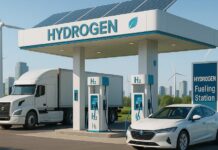
The three bays at a hydrogen refueling station in Nanhai were empty for an hour on one of the recent Wednesday afternoons when The Straits Times was there. There was only one electric scooter that came in, and it was to bring the station head’s lunch.
The facility’s leader, Mr. Xie Linhui, said it only sells less than half of the two tons of goods it needs to move each day to make funds. He said that when business is good, about 60 to 70 cars come to fill up, mostly public buses, sanitation trucks, and logistics trucks.
There, the state is involved – In the past few years, businesses supported by the local government have bought or leased hydrogen-powered vehicles to use for public services like buses, road sweepers, and sprinkler trucks.
But even help from the government has started to show signs of stress. In January 2026, the local news outlet Yicai went on to report that about 50% of Nanhai’s hydrogen bus fleet was not working because it was too expensive to run and not enough people were using it.
A driver of a hydrogen bus told ST that it costs about 200 yuan or S$37 to 300 yuan more to run each day than an electric bus. He said, Hydrogen is expensive.
One of the problems that Beijing wants to solve is the cost.
On March 16, 2026, it went ahead and announced a pilot program that aims to bring the price of hydrogen down to less than 25 yuan per kilogram for end users by 2030. Yicai says that prices are usually higher than 35 yuan per kilogram as of now.
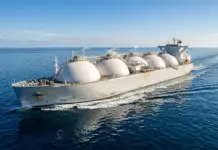
With the idea of hydrogen energy as a future industry, Beijing also wants to use hydrogen more in industry, like making green ammonia, which can be used as fertilizer or as fuel for ships.
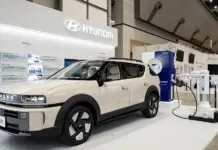
This is a step up from the previous focus on promoting fuel cell electric vehicles – FCEVs, which run on hydrogen.
It is well to be noted that Beijing’s goals for vehicle adoption have not been met. China sold about 40,000 FCEVs by the end of 2025, which was short of its goal of 50,000. It now wants to have 100,000 FCEVs on its roads by 2030, which is less than the one million it thought it would have in 2016.
Hydrogen-powered transportation has also had problems in other places. According to Nikkei Asia, sales of FCEVs in Japan fell by 83% from 2021 to 2025, and the number of refueling stations fell by 10%.
A report from the International Energy Agency says that the predicted production capacity of low-carbon hydrogen by 2030 fell by almost a quarter in 2025 compared to the year before. This was because projects were delayed or canceled. Most of them were projects for green hydrogen.
China is moving forward, even though the math may not add up right now and some apps are having trouble getting off the ground. Ms. Shen Xinyi, a researcher at the Centre for Research on Energy and Clean Air think tank, said that hydrogen is one of the few possible ways to get rid of carbon in hard-to-reach areas such as steel, chemicals, and long-distance transport. These are fields where just switching to electric power might not be enough to cut down on emissions.
She adds, So even if the near-term economics are weak, there is a strong incentive to prepare early for long-term decarbonization needs.
Professor Lin Boqiang, who is the dean of the China Institute for Studies in Energy Policy at Xiamen University, said that China thinks that building more renewable energy sources will eventually make green hydrogen cheaper.
The country is quickly putting up solar and wind farms. In 2025, it added more solar and wind power than the rest of the world put together.
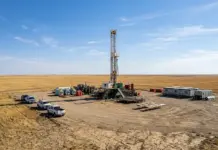
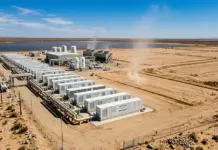
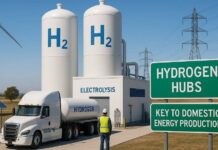
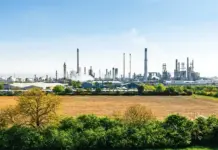
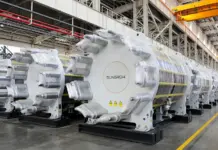
Electrolysis is a process that can split water into hydrogen and oxygen, which can then be used to make clean hydrogen. China is building green hydrogen production bases in places such as Inner Mongolia, where this is possible.
Prof. Lin said, The prerequisite is that wind and solar must be extremely cheap, and the scale extremely large, to be able to truly support hydrogen energy. Mr. Li Shuo, who is the director of the China Climate Hub at the Asia Society Policy Institute think tank, said that China has already mastered clean technologies like solar and wind and is keen to expand to the next battlefield. They want to get ahead of the game early on.
He said that China probably thought that the business case for green hydrogen would eventually be there, maybe not in the 2020s but in the 2030s. By making an early bet, China would indeed be in a good position when this happened.
Mr. Li said that China is indeed big enough to put bets in many different places and that sometimes, those bets will pay off.