























Heidelberg Materials UK is the first company in the UK using hydrogen to remove carbon from asphalt production, and that too on a large scale.
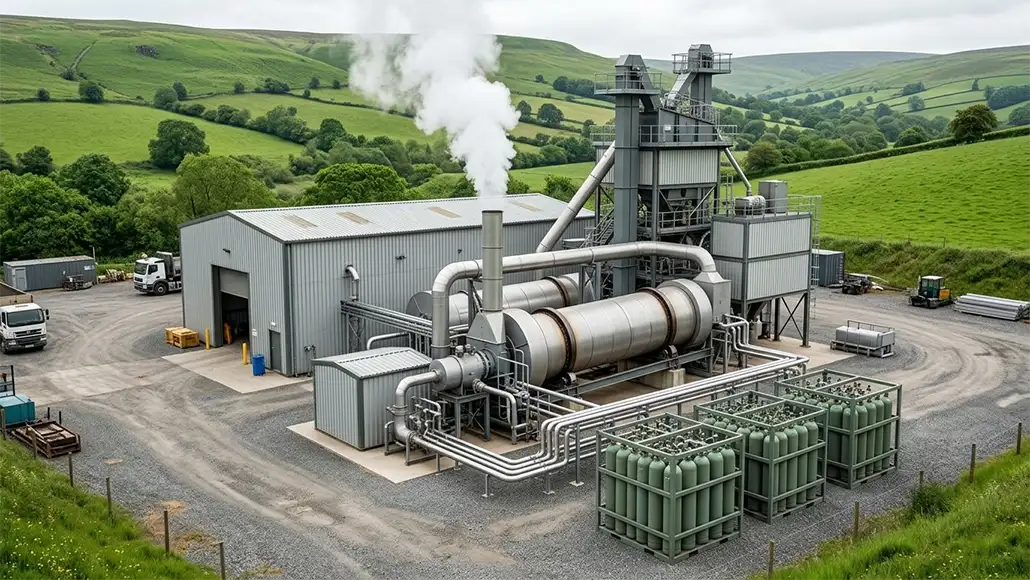
The trial to remove carbon from asphalt production was done at the Criggion plant of the company that’s located in Powys, mid-Wales. It has been in the works for three years and happens to be a part of the Industrial Hydrogen Accelerator program by the government. The Department for Energy Security and Net Zero – DESNZ is partially funding it.
During the test phase, hydrogen took the place of liquid fossil fuels and made over 1,300 tons of asphalt without any reports of an alteration within the quality or even performance of the material.
Heidelberg Materials says that the trial went on to cut the Scope 1 emissions – the emissions from using fuel on-site by 76% and also cut the total carbon footprint of the asphalt by 23%. The trial went on to use up 4,522 kg of hydrogen, which the company says went ahead and saved around 25,105 kg of CO₂. It also says that if this method were used in the whole UK asphalt industry, it could as well help save as much as 450,000 tons of CO₂ each year.
It is well to be noted that the experiment is one of the many recent efforts so as to test low-carbon heat sources within heavy industry, where process heat often gets supplied by way of natural gas or any other fossil fuels and where electrification can indeed be quite a challenge. Apparently, asphalt plants require heat at high temperatures in order to dry and bind aggregates, which makes them an ideal target to use alternative fuels like hydrogen and biofuels.
A variety of stakeholders in the industry are pushing for hydrogen to play a bigger role. Heidelberg Materials is part of Made with Hydrogen, a group of manufacturers including companies that create building materials. The group says that hydrogen could help businesses reach their net-zero objectives and is asking the government to be clearer as to how the technology ought to be used.
However, there are problems that hydrogen will have to deal with before it can be made wide use of. Low-carbon hydrogen happens to be more expensive compared to regular fuels, and its environmental benefit depends on how it’s made, which is either by electrolysis using renewable electricity or green hydrogen or through capturing emissions from fossil-based production – blue hydrogen. The speed at which industry can switch will depend on things like infrastructure when it comes to hydrogen supply and storage, availability of consistent low-carbon hydrogen volumes as well as safety and regulatory frameworks.
The Industrial Hydrogen Accelerator program, which gets funded by DESNZ, looks forward to testing the usage of hydrogen in a variety of industrial processes while offering information for policy and investment decisions. As the government and industry collaborate to reach the net-zero targets of the UK, tests like the Criggion project will help them figure out as to how much it is going to cost, how well it is going to work, and how much it is going to cut down on emissions.
The Criggion trial is indeed just another instance of how hydrogen can be used in order to heat things up in industry at high temperatures. The next things that the policymakers and manufacturers need to figure out are how to boost supply, minimize the costs, and make sure that the hydrogen that is used really does lower carbon emissions throughout its entire life cycle.
Heidelberg Materials UK CEO, Simon Willis, said that “if we are to reach our net zero ambitions, we need to consider carbon reduction measures across all areas of our operations. Fuel switching to hydrogen is one of these along with, for example, the development of carbon capture and storage, the use of alternative and secondary materials, and developing circular solutions. He further adds that “Hydrogen will be a vital solution to decarbonize heavy industry where electrification is difficult, and this successful demonstration of its potential to produce low-carbon asphalt for the construction industry is a major step forward.”