
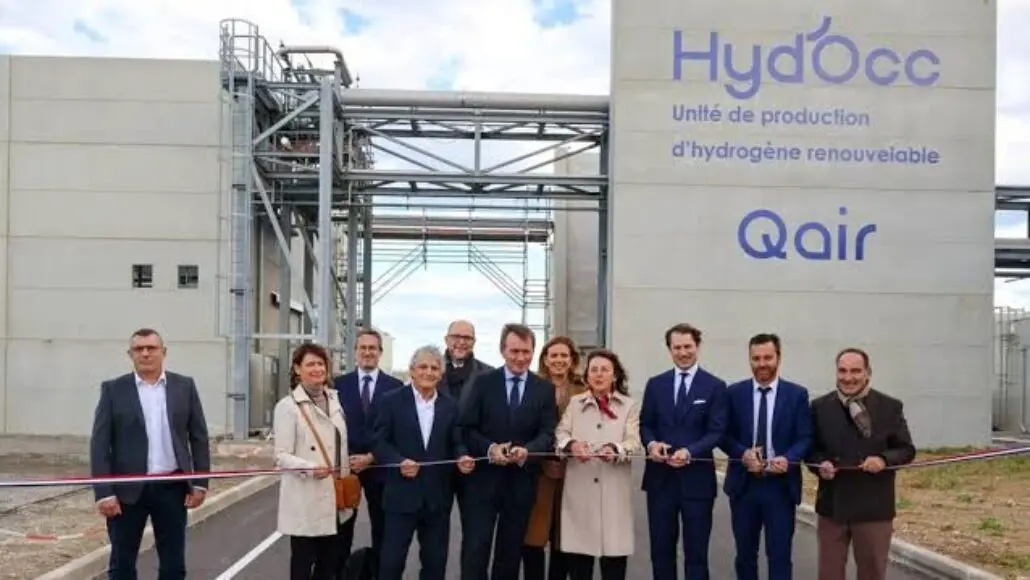

French independent renewable company Qair launches Hyd’Occ, the largest renewable hydrogen production plant of France. The site is aimed at decarbonizing heavy and intensive transport and is an important factor in the establishment of a solid renewable hydrogen infrastructure at the regional and European levels, right from production to end use. It is backed by a network of hydrogen refueling stations located in Occitanie, which opened in spring 2026 and is a part of the European H2 Corridor.
It is well to be noted that the first phase of the plant, which has a 20 MW capacity, is being built at Port-la Nouvelle from June 2023 and is aimed at producing 2,700 tonnes of renewable hydrogen every year by water electrolysis from renewable electricity. With a capacity of 20 MW, it is one of the largest electrolyzers in the country, representing almost 30% of the roughly 70 MW of commissioned electrolysis capacity in France. This equates to 27,000 tonnes of CO2 which is apparently due to this not being emitted per year. The second phase will bring the installed capacity to 40 MW, raising the annual capacity to 5,400 tonnes. The project’s total investment is €130 million, including €55 million in bank financing provided by Crédit Agricole and Bpifrance for the plant and the stations ecosystem.
From the 1st molecule to the European accreditation
After successful testing, this largest renewable hydrogen production plant of France generated its first molecules of renewable hydrogen in December 2025. The first one was symbolically handed over to the crew of Energy Observer, partner of Qair Group, at the time of its halt in Port-La Nouvelle Hyd’Occ and is carrying out its last adjustments and is getting the RFNBO – renewable fuel of non-biological origin certifications. This European structure certifies the renewability of the produced hydrogen, which, by the way, is an assurance asked for by transport operators and manufacturers dedicated to decarbonizing their activities.
Refueling network for the European corridor
The production plant has got the support of a network of refueling stations, two of which – in Béziers and Narbonne – were already put into service in the spring of 2026. They will each be expected to deliver 600 kg of renewable hydrogen per day, mainly when it comes to light and heavy goods vehicles, coaches, buses, and commercial fleets, where hydrogen can be a sustainable zero-emission alternative to fossil fuels.
The stations were chosen in response to the call for projects – Corridor H2 Occitanie, which is a joint initiative of the Occitanie Region and the European Investment Bank, as well as the European Union via the Connecting Europe Facility – CEF. The project is intended to create a zero-emission European transport corridor from the Iberian Peninsula to Northern Europe for heavy-duty transport using renewable hydrogen.
The station in Béziers provides 13 hydrogen buses for the urban community of Béziers. The Narbonne station also refueled a hydrogen heavy goods vehicle coming from the Netherlands in October 2026 within the framework of the HyWayOne Challenge organized by Hydrogen Architects. The lorry left Pesse, in the province of Drenthe, and travelled to Barcelona prior to returning, traversing around 3,800 kilometres throughout six European countries, which is proof that the north-south hydrogen corridor is taking standard form and that Occitanie is an important stop along the route.
More than road transport
The hydrogen from Hyd’Occ will also power HydrOMer, which is the first partially hydrogen-powered dredger in the world. The vessel will be fitted with a 200 kW fuel cell and stocked with hydrogen transported in 20-foot storage containers, thereby reducing around 700 tonnes of CO2 emissions per year and operating with zero emissions while docked in the ports of Port-la-Nouvelle, Sète-Frontignan as well as Le Grau-du-Roi.
In general, Hyd’Occ promotes innovation and the development of market opportunities when it comes to green molecules. Beyond heavy-duty transport, hydrogen also offers a path to sustainable energy storage – renewable electricity can be turned into hydrogen and stored, thereby assisting in smoothing out volatility in prices associated with the massive inflow of fluctuating renewable energy onto the grid.