
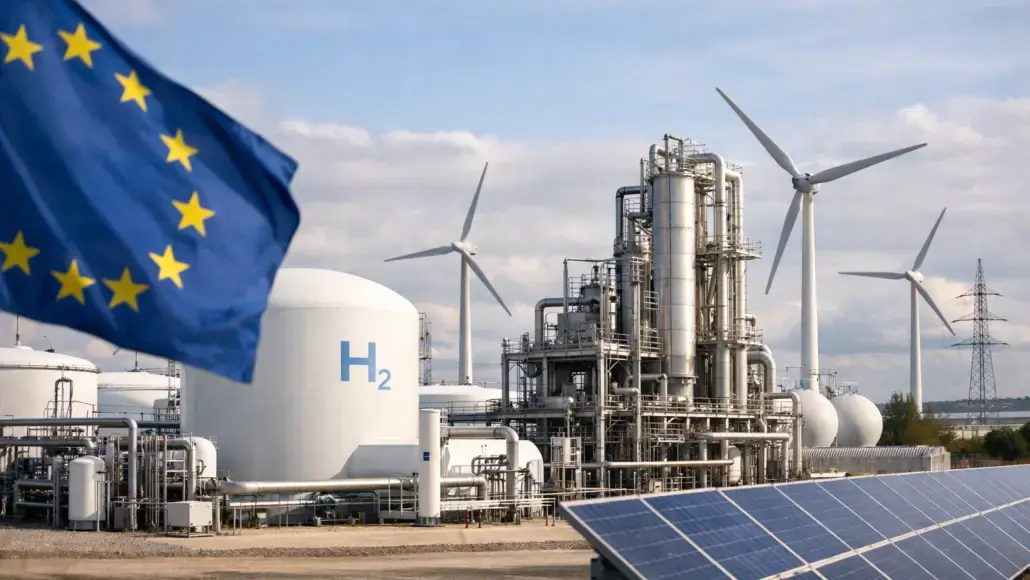

The European Commission is considering to postpone green hydrogen production rules as the market is developing a bit slower than anticipated, Hydrogen Insight stated on October 29, 2026.
The changes affect the delegated act of the EU on renewable fuels of non-biological origin – RFNBO, which lays out the conditions in which hydrogen produced from electricity can be considered renewable under European law.
Brussels has admitted that the development and consumption of renewable and low-carbon hydrogen is growing slower than anticipated.
In April 2026, the Commission committed to accelerating a targeted review of the production criteria, originally planned for 2028, while safeguarding investments made under the current rules.
The first suggested modifications were anticipated by the end of June 2026 but have been pushed back.
Dan Jørgensen, the EU Energy Commissioner, confirmed at the European Hydrogen Week that there would be amended delegated acts open for public comment.
He added, “With these updated delegated acts, we seek the flexibility the industry needs to get the market started.”
Some requirements will be delayed, but changes are anticipated to be enforced before the end of 2026, Hydrogen Insight reported.
The Commission has not yet published any final amendment detailing which rules are affected or when they must be replaced.
Review of Additionality and Hourly Matching Rules
The existing RFNBO framework already contains requirements for the renewable electricity utilized to generate hydrogen via electrolysis.
According to the additionality rules, producers are generally required to buy electricity from newly constructed renewable generation plants that satisfy certain commissioning and funding requirements.
The renewable electricity installation must generally have been commissioned no more than 36 months prior to the hydrogen production facility being operational.
Projects commencing operations prior to 1 January 2028 are eligible for a transitional waiver from additionality criteria until 2038. The exemption shall not apply to any incremental production capacity that is added subsequent to the 2028 cutoff.
Electrolyzers commencing operation in 2028 shall generally be required to meet the additionality conditions straightaway, subject to other waivers under the regulation.
The framework also calls for temporal alignment of hydrogen production and renewable electricity generation.
Under current rules, renewable electricity and hydrogen production can be paired in the same calendar month until December 31, 2029.
After January 1, 2030 onwards, the standard requirement goes on to become hourly matching.
The regulation also specifies geographical correlation standards to determine where electricity is produced in relation to the electrolyzer.
No official revised dates have been accepted.
Industry groups want to delay until 2035
Hydrogen developers as well as trade associations have been lobbying Brussels to prolong the current transition periods.
In July, a coalition of Hydrogen Europe, Methanol Institute, Eurogas, the eFuel Alliance, and various other industry organizations proposed modifications to Delegated Regulation (EU) 2023/1184.
The organizations are calling for the additionality transition to be extended from 2028 to no less than 2035.
They also want to push back the move to hourly matching, which is set for 2030, to 2035 at the earliest and keep monthly electricity matching as usual.
The groups say the present timetable is not reflective of the pace of renewable electricity development, hydrogen infrastructure build-out, or even industrial demand.
They also sought protection for projects that had been developed, contracted, or financed as per the current rules.
A wider group of European associations renewed their call in September 2026 for the Commission to wrap up its review by the end of 2026.
Study Questions Value of Easing Hydrogen Rules
A study commissioned by the Environmental Defence Fund Europe, released October 15, 2026, reached an alternative conclusion on relaxing current requirements.
The study, done by CLIMACT, University of Liège, and Systemik, estimated relaxing additionality and hourly matching could just reduce hydrogen production costs by about €0.10-€0.25 per kilogram, which is about $0.11-$0.28/kg in the near term.
It also found that relaxing both requirements might raise EU greenhouse gas emissions by over 15 million tonnes in 2035 in some modeled scenarios.
Those are modelling outcomes, not measured findings.
Beyond the production rules themselves, the study said significant obstacles remain, including high electricity prices, weak demand for hydrogen, infrastructure limitations, and challenges with securing long-term purchase agreements.
Commission drafts revised hydrogen strategy
The idea to postpone green hydrogen production rules comes as the European Commission is working on a revised hydrogen strategy.
On October 26, 2026, Brussels launched a four-week call for evidence and targeted stakeholder consultation when it came to hydrogen demand, expenses, investment obstacles, infrastructure requirements, and supply-chain viability.
The consultation will close on 23 November 2026.
The new strategy is being prepared in parallel with the EU’s renewable energy framework for the 2040 period.
The review of the production rules is distinct from the Renewable Energy Directive discussion on targets for industrial hydrogen consumption beyond 2030.
It is not yet clear if the Commission will shift either the additionality deadline or the hourly-matching time frame to 2035.