
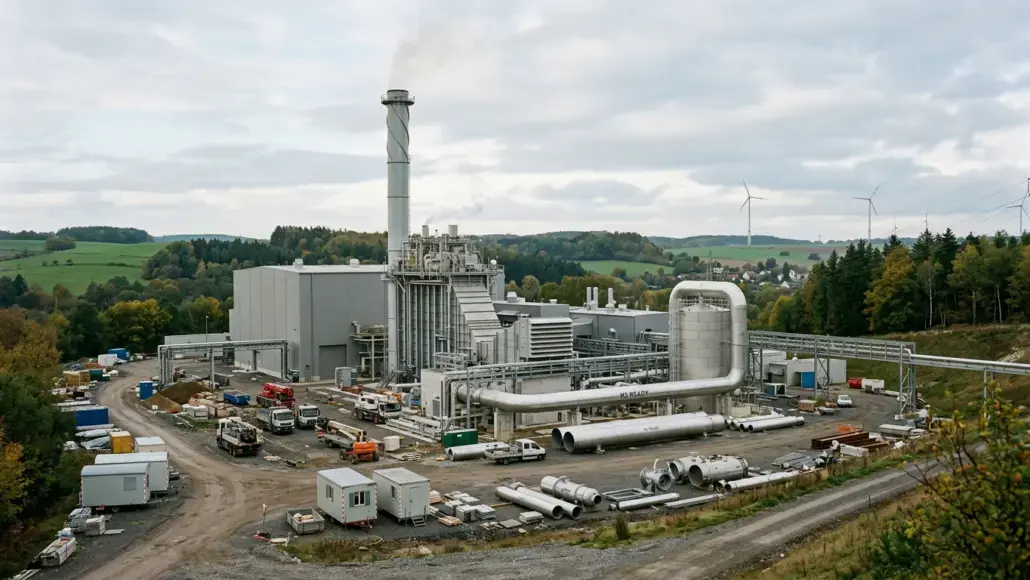

In a recent move, Germany granted contracts to build 11 hydrogen-ready power plants with a total tender capacity of 5.16 GW worth around 12 billion euros, or $13 billion, for a period of 15 years.
The projects have been selected by the Federal Network Agency to aim to boost the security of electricity supply as the country ramps up renewable generation and gradually phases out coal. Consumers are likely to face a levy on electricity to pay for the costs.
LEAG was awarded 7 contracts for projects located in Brandenburg, Saxony, and Bavaria, and RWE got 3 projects based out of Voerde, Werne, and Weisweiler.
The other award went to Stadtwerke Karlsruhe for a 54MW plant. The projects by RWE amount to around 2.1 GW of capacity, and the projects that are successful are scheduled to be ready from November 2031.
The awards support Germany’s strategy to create 12 GW of new dispatchable power capacity via auctions in 2026. The plants are set up to at first run on natural gas and then switch to hydrogen as supplies of fuel and infrastructure standards evolve, thereby helping to achieve the longer-term objective of achieving climate neutrality by 2045 for the country.
That transition is beyond turbine specifications. Germany will require adequate low-carbon hydrogen manufacturing, transportation, and storage facilities along with commercially feasible fuel contracts. If they come online less quickly compared to the generation fleet, the plants may consume natural gas longer than expected.
Interestingly, hydrogen-powered generation also has a big efficiency penalty. After the steps of electrolysis, storage, and transport, as well as generation of electricity, based on the system configuration, normally only some 30% to 40% of the initially generated electricity can be retrieved. This renders hydrogen more inefficient compared with batteries for storage for limited periods, but it could provide dispatchable power over longer periods of low renewable production.
Costs and alternatives still under review
The 15-year agreements offer revenue assurance to plants that can operate occasionally, but they also pass a portion of the investment expense on to the electricity customers. The primary issue is if the capacity will provide enough dependability benefits to support that cost as alternatives like batteries and grid expansion, as well as demand response systems, mature.
The strategy by Germany is part of a broader push to keep dispatchable power on the grid while at the same time cutting emissions. Singapore and Oman are also developing hydrogen-ready power plants, and South Korea has established a specific clean hydrogen electricity auction for annual purchases of 500 GWh.
The German awards take new capacity closer to construction, however their enduring climate value will be contingent upon how rapidly carbon-free hydrogen is made accessible and if plants can switch out of natural gas without an excessive cost to consumers.